





- Understand Your Ideal Customer Before Spending Money
- Build Your Customer Acquisition Funnel
- Choose Growth Channels Based on Customer Behaviour
- SEO: Build Long-Term Customer Discovery
- Paid Advertising: Generate Demand Faster
- Understand Customer Acquisition Cost (CAC)
- Build a Website That Converts Visitors Into Customers
- Founder Branding: Build Trust Before Customers Buy
- CRM: Turn Opportunities Into Customers
- AI and Automation: Improve Growth Efficiency
- Partnerships and Referrals: Growth Through Trust
- Example €10,000 Monthly Growth Budget
- A Practical 90-Day Customer Growth Plan
- What Founders Should Measure Every Month
- Final Takeaway
Guide for comprehending customers, choosing correct growth channels, lowering the cost of acquiring new customers and creating an efficient customer acquisition process.
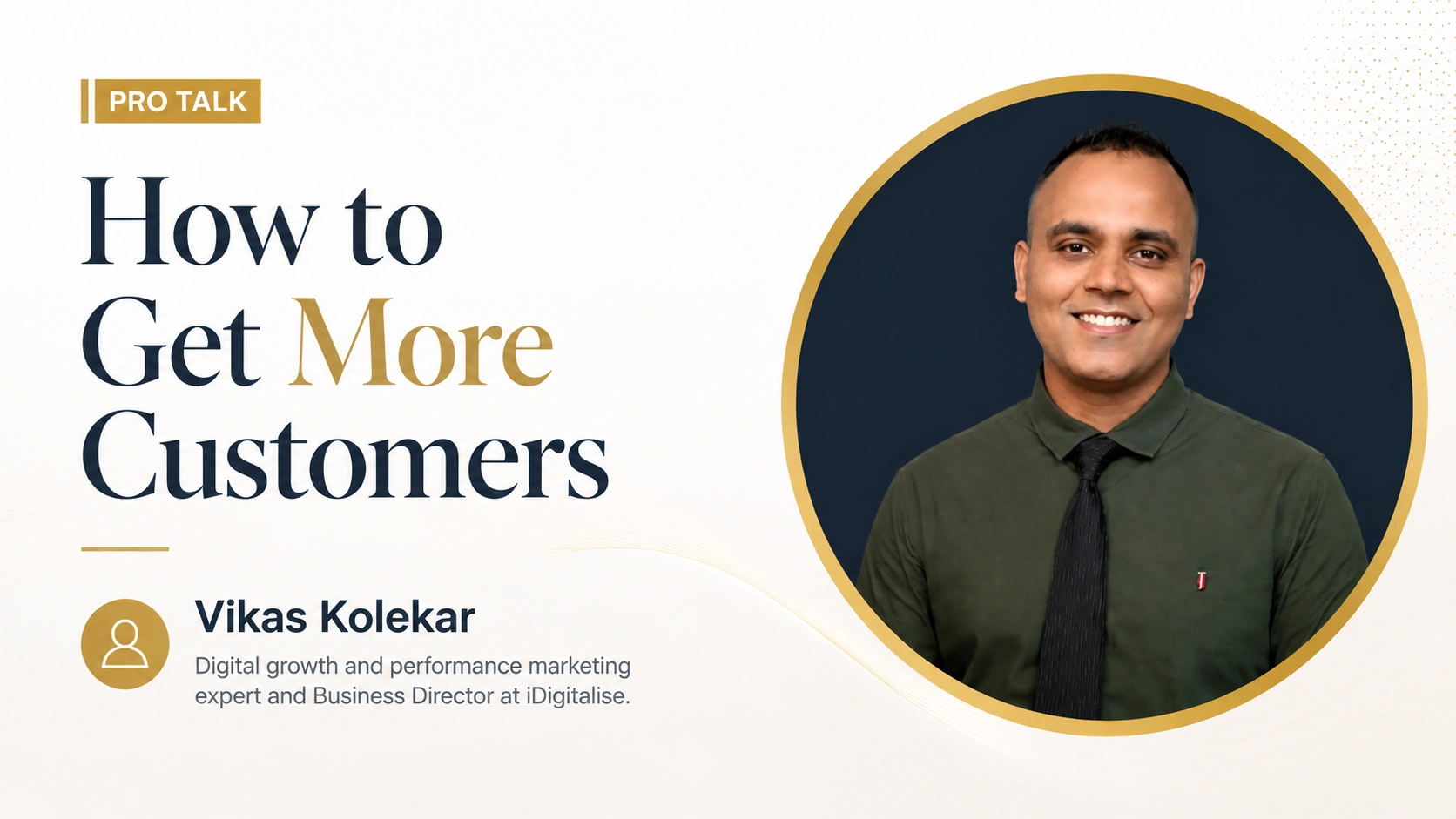
By Vikas Kolekar | ProTalks
Last updated: August 2026
Introduction: Growth Starts With Customers, Not Marketing Channels
Every business wants more customers. Yet for many founders, customer acquisition remains one of the biggest challenges.
A company can have a strong product, talented people and a clear vision, but growth becomes unpredictable when customer acquisition depends only on referrals, occasional campaigns or trying different marketing channels without a clear strategy.
Many businesses make the mistake of starting with marketing activities before understanding their customers. They spend resources on advertising, content and social media without fully realizing who their ideal customer is, what pain point they address and why people should select them.
Sustainable growth does not depend on being everywhere but rather on the ability to comprehend customers, pick the right channels and create an efficient system to transform awareness into money.
Here is how startups, SMEs and companies with growth potential can create a customer acquisition process in 2026.
Understand Your Ideal Customer Before Spending Money
Many companies market themselves even before they know who their ideal customer is.
They launch campaigns, release content, and make investments in various platforms, but have no idea whether they are reaching the right audience. The consequence of all of this is lost money and a failure to convert.
Before starting to spend money acquiring customers, there are five critical questions that every founder should ask himself:
| Question | Why It Matters |
| Who is your customer? | Determines your target audience and approach to marketing |
| What problem are they solving? | Provides a basis for creating relevant messages |
| Where do they look for solutions? | Helps choose the right marketing channels |
| What influences their buying decision? | Improves conversion |
| Why should they choose you? | Creates clear positioning |
Customers do not buy simply because a company exists. Customers buy because of the assistance that an organization gives in solving a problem, saving time, cutting cost, increasing efficiency, or achieving some intended outcome.
For instance, a software vendor should not just tell customers about the attributes of their products but focus on how the solution helps customers work faster or improve their results.
Good marketing starts from understanding customers, not from advertisement.
Build Your Customer Acquisition Funnel
Getting attention is only the first step. Businesses grow when they understand how someone moves from discovering a brand to becoming a customer.
A simple customer journey looks like:
Awareness → Interest → Enquiry → Conversation → Purchase → Retention → Referral
Each stage requires different actions and measurements.
| Stage | Example Metrics |
| Awareness | Reach, impressions, brand visibility |
| Interest | Website visits, engagement, content interaction |
| Acquisition | Leads, enquiries, conversations |
| Conversion | Customers, revenue, contracts |
| Retention | Repeat purchases, renewals |
| Referral | Recommendations, reviews |
This funnel will help founders pinpoint the area where the growth is hindered.
For example, if there is low visibility – more people need to become aware of the business. Lots of traffic to the website but not enough enquiries can mean confusing marketing messages. Lots of enquiries but not enough sales can mean issues in follow-up or sales processes.
Growth is not an activity. Growth is improving each step of the customer journey.

Choose Growth Channels Based on Customer Behaviour
Not all businesses use the same marketing channels.
Which channels to use depend on where and how your customers conduct their research and decision making process.
| Business Type | Effective Growth Channels |
| SaaS companies | SEO, content, LinkedIn, partnerships |
| Digital agencies | Founder branding, LinkedIn, referrals |
| Local businesses | Google Maps, reviews, local SEO |
| Healthcare businesses | SEO, reviews, Google Ads |
| Real estate businesses | Search ads, social media, portals, CRM |
| E-commerce brands | SEO, paid ads, influencers, email |
One common pitfall is imitation of the competitor’s marketing strategy without considering if it suits your customers.
Educational content and LinkedIn visibility may be useful for a B2B software company, whereas Google Maps, reviews and local SEO may work better for a local business.
The best channel is not the most popular one. It is the one where your customers already make decisions.
SEO: Build Long-Term Customer Discovery
Search visibility allows companies to connect with their consumers based on needs they already have.
Person who searches:
- “best accounting software for startups”
- “digital marketing agency in Europe”
- “dentist near me”
- “property investment opportunities”
is already looking for information or a solution.
Good SEO strategy works in making customer choices rather than just working on rankings.
Businesses should create:
- Helpful guides
- Industry insights
- Comparison articles
- Service pages
- Case studies
- Customer-focused resources
The goal is not only to attract visitors. The goal is to attract the right visitors who are more likely to become customers.
Paid Advertising: Generate Demand Faster
SEO allows for long-term visibility, but paid advertising allows for quick results in acquiring new customers.
Google ads, LinkedIn ads, and Meta ads may work well if your campaign is built on customer intent.
But the success of an ad campaign does not necessarily depend on cheap clicks.
Businesses should measure:
| Metric | Why It Matters |
| CTR | Shows message relevance |
| CPC | Cost of attracting visitors |
| CPL | Cost of generating enquiries |
| Conversion Rate | Website effectiveness |
| CAC | Cost of acquiring customers |
| ROI | Business return |
A low-cost lead is not always a valuable lead.
A customer that cost €500 but will bring in a lifetime value of €10,000 may be much more profitable than a €50 enquiry that fails to convert.
The aim is to profitably acquire customers, not just get more leads.
Understand Customer Acquisition Cost (CAC)
Customer Acquisition Cost is one of the most important numbers every founder should understand.
CAC = Total Marketing & Sales Cost ÷ Number of New Customers
Example:
| Monthly Investment | New Customers | CAC |
| €10,000 | 100 | €100 |
| €10,000 | 50 | €200 |
| €10,000 | 20 | €500 |
A higher CAC is not automatically a problem.
A company selling a €20 product and a company selling a €20,000 service cannot have the same acquisition economics.
Founders should compare CAC with:
- Customer lifetime value
- Profit margin
- Retention rate
- Sales cycle
The objective is not finding the cheapest customer. It is acquiring valuable customers at a sustainable cost.
Build a Website That Converts Visitors Into Customers
Many businesses spend money bringing visitors to their website but fail to convert that attention into enquiries or sales.
A strong website should quickly answer:
- What do you offer?
- Who do you help?
- Why should customers trust you?
- What should they do next?
Key points are:
- Good positioning
- Message focused on customers
- Testimonials
- Case studies
- Effective calls-to-action
- Enquiry process simple
A website is not just for explaining your business. It needs to assist in customer decision making.
Founder Branding: Build Trust Before Customers Buy
For a lot of companies, especially B2B businesses, people trust people before they trust brands.
The founder can provide useful content that goes way beyond conventional advertising.
Founder created content can help a business:
- Create credibility
- Gain partnerships
- Generate leads
- Create authority in the industry
Examples of useful LinkedIn content:
| Content Type | Example |
| Lessons | What I learned while starting my business |
| Industry insights | Market information |
| Stories | Experience as a founder |
| Expertise | Solution to customer problems |
| Opinions | Trends of the future |
Company pages tell what the company does. Founder pages tell why people should trust the company.
The development of a successful business also needs the appropriate leadership mentality. See Why Some Businesses Grow While Others Remain Stagnant to learn about Natasha Aleksovska’s opinion on sustainable growth of businesses.”
CRM: Turn Opportunities Into Customers
Lead generation is just the start.
Many organizations miss out on customers because they do not have any systematic process of follow-ups.
A CRM system assists organizations to manage their opportunities:
| Stage | Purpose |
| New Lead | Seize opportunity |
| Contacted | Initiate communication |
| Qualified | Know customer requirements |
| Proposal | Offer solution |
| Negotiation | Clear doubts |
| Won | Acquire customer |
| Retention | Establish relationship |
A CRM system enables the founder to know how customers come through and where opportunities get lost.
AI and Automation: Improve Growth Efficiency
AI is revolutionizing the way business works.
Now smaller teams can automate those processes that once required considerable time and effort.
Examples of practical implementation may be:
- Customer service
- Prospect qualification
- Sales follow-ups
- Content creation
- Market research
- Work process automation
However, AI must assist business decision-making, not dictate it.
Successful companies leverage both people and AI.
Partnerships and Referrals: Growth Through Trust
It’s not necessary for every client to come through ads.
Collaborations and referrals usually result in good opportunities because trust is already established.
Some examples are:
- Strategic alliances
- Professional networks
- Customer referral programs
- Business collaborations
- Networking
The happy customer becomes the best source of growth for the company.
Example €10,000 Monthly Growth Budget
Every business requires a different approach, but an example growth budget could look like this:
| Activity | Budget |
| SEO & Content | €2,500 |
| Paid Advertising | €3,000 |
| Founder Branding | €1,000 |
| CRM & Automation | €1,000 |
| Partnerships | €1,000 |
| Testing & Optimisation | €1,500 |
| Total | €10,000 |
The appropriate split will depend on the business model, competition, customer value, and maturity level.
A Practical 90-Day Customer Growth Plan
Month 1: Build the Foundation
This will involve customer knowledge, positioning, website messaging, tracking and an effective customer acquisition strategy.
Month 2: Generate Opportunities
Carry out campaigns, produce quality content, make connections and conduct effective customer discussions.
Month 3: Improve Conversion
Evaluate outcomes, enhance follow-ups, refine the customer journey and spend more money where there is value creation.
What Founders Should Measure Every Month
A simple growth dashboard can help founders make better decisions.
| Metric | Why It Matters |
| Website traffic | Visibility |
| Leads | Demand |
| Conversion rate | Sales efficiency |
| CAC | Acquisition cost |
| Revenue | Business impact |
| Customer lifetime value | Long-term value |
| Retention rate | Customer loyalty |
| Referral rate | Organic growth |
The best businesses do not measure marketing activity alone. They evaluate the contribution of marketing towards business growth.
Final Takeaway
Increasing customer numbers in 2026 should not be about following all the new marketing fads and engaging in all possible channels.
Businesses that grow consistently will be those that understand their customers, communicate their value clearly and build repeatable systems for attracting, converting and retaining the right audience.
The biggest shift for founders is moving away from asking:
“How can we get more leads?”
and asking:
“How can we build a predictable system that creates valuable customers?”
That mindset helps businesses move from short-term marketing campaigns to sustainable growth.
Sustainable growth also depends on the standards behind the business. Explore Raise Your Standards Before You Raise Your Business for more leadership insights from Pasquale Minasi.”
About the Author
Vikas Kolekar is a digital growth and performance marketing expert and Business Director at iDigitalise. He works with businesses across healthcare, real estate, technology and service industries, helping brands build measurable growth systems through SEO, paid advertising, content, CRM and digital strategy.
Through ProTalks, Vikas shares practical business insights focused on customer acquisition, growth strategy and the decisions businesses need to make to build sustainable visibility and revenue.
Connect with Vikas Kolekar
Interested in working with or consulting with this expert? Submit your details below.