





For most of the last decade, marketers have been trained to think about visibility in familiar ways. Where does a brand rank on Google? How much organic traffic does it generate? Which campaigns are producing qualified leads? How often is the company mentioned online, and how strongly does it perform against competitors?
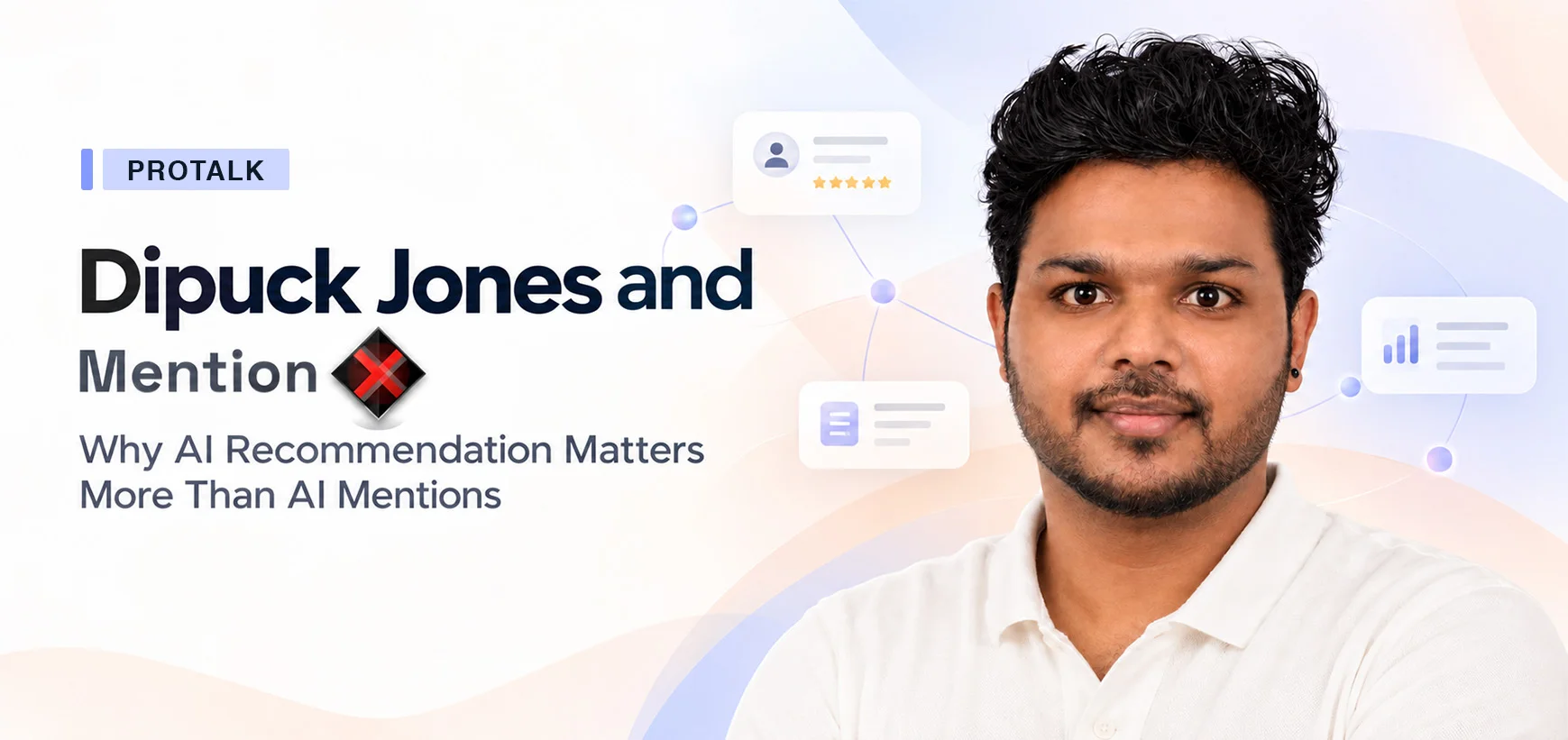
As AI tools started becoming part of how people research products, compare companies and make buying decisions, another form of visibility began to matter. Dipuck Jones noticed that shift early, but what interested him was not simply whether brands appeared in ChatGPT, Gemini or other AI platforms. He was more interested in what happened after that.
A brand could be mentioned in an AI-generated answer and still not be the brand that the system actually recommended. For someone with a strong performance marketing background, that distinction mattered. Visibility had value, but recommendation was closer to commercial intent.
That idea became the foundation of MentionX.
Based in Berlin, Dipuck Jones is a growth and performance marketer with more than a decade of experience across SaaS, paid acquisition, SEO, digital marketing, analytics and growth. MentionX grew out of that experience and from a question that increasingly felt important to marketers: when someone asks an AI platform which company, product or service to choose, is your brand simply visible, or is it actually being recommended?
That is the problem MentionX is trying to make measurable.
From Performance Marketing to AI Visibility
MentionX did not begin as an abstract idea about artificial intelligence. It came from Dipuck’s day-to-day work in marketing.
As ChatGPT, Gemini and other AI platforms became more widely used, more marketers started asking whether their brands were appearing in AI-generated answers. It was a logical concern. Search behaviour was beginning to change, and businesses were trying to understand what that meant for brand discovery.
Dipuck felt the discussion was too heavily focused on one metric: mentions.
From a performance marketing perspective, that was incomplete. A company can appear in an answer several times and still lose the actual recommendation to a competitor. The same principle already exists in traditional digital marketing. High traffic does not guarantee conversion, strong reach does not guarantee preference, and visibility alone does not necessarily create a meaningful business outcome.
Dipuck saw the same gap emerging in AI discovery. The more useful question was not simply whether AI mentioned a brand, but whether AI trusted it enough to recommend it when a potential customer was deciding between options.
That distinction became central to MentionX.
Building MentionX Around Recommendation, Not Vanity Metrics
MentionX was developed to give marketers a clearer view of how their brands appear across major AI engines. Rather than reducing AI visibility to one generic score, the platform looks at several signals that together provide a more useful picture of how a brand is being represented.
These include mention rate, recommendation rate, first-choice rate, share of voice, average position, sentiment, competitor performance, buyer prompts, topics, citations and source influence. MentionX currently tracks these signals across 10 AI engines: ChatGPT, Gemini, Google AI Overviews, Google AI Mode, Microsoft Copilot, Meta AI, DeepSeek, Claude, Perplexity and Grok.
The thinking is practical. If AI is becoming part of how people make decisions, marketers need more than proof that their brand appeared somewhere in an answer. They need to know whether competitors are being preferred, which external sources are influencing AI-generated results, where the brand performs well and where it disappears entirely.
They also need to understand whether visibility is actually translating into recommendation.
How MentionX Looks at AI Visibility
| Metric | What It Helps a Brand Understand |
| Mention Rate | How often the brand appears in AI-generated answers |
| Recommendation Rate | How often AI actively recommends the brand |
| First-Choice Rate | Whether the brand is positioned as the leading option |
| Share of Voice | How the brand compares with competitors across AI results |
| Average Position | Where the brand tends to appear within responses |
| Competitor Performance | Which competing brands are mentioned or recommended more often |
| Sentiment | How AI platforms describe or frame the brand |
| Buyer Prompts | How the brand performs against decision-driven queries |
| Topics | Which subjects and categories the brand is associated with |
| Citations | Which sources appear in AI-generated responses |
| Source Influence | Which external websites may shape how the brand is understood |
For Dipuck, the challenge was never simply collecting AI responses. The harder part was turning large volumes of generated answers into something a marketer could actually use.
That thinking led to features such as engine-level comparisons, citation intelligence, Prompt Proof Agent and an auditable trail of the AI responses being analysed.
Perhaps the most important idea remains what Dipuck describes as the Mention-to-Recommend gap. A company may be visible, but that does not mean it is preferred. For marketers, that is a much more commercially relevant distinction.
The Founder Journey Behind MentionX
The product story is only one part of MentionX. The personal story behind it is equally important.
Dipuck was building the company during a period when life was already demanding a great deal from him. He was preparing to become a father for the first time, managing family responsibilities, dealing with career uncertainty and at the same time trying to build a serious SaaS product without a large team, outside funding or an agency behind him.
That meant working across several parts of the business himself, including product direction, UX, the website, positioning, content and go-to-market. It was not a neatly divided founder role. It was a case of identifying what needed to be done next and doing it.
Interestingly, Dipuck does not describe the product itself as the hardest part. The greater challenge was uncertainty.
When resources are limited, small decisions carry more weight. A $20 software subscription becomes something to think about carefully. A feature that sounds simple can consume several days. A difficult week can make a founder question whether the broader idea is working at all.
Another challenge was learning that other people would not always understand his vision at the same speed he did. That forced him to become more precise about what MentionX should be, who it was for and which problems genuinely deserved attention.
Instead of trying to build everything at once, he simplified the process. One product improvement, one page, one customer conversation and one launch asset at a time.
That approach gradually shaped how he thinks about entrepreneurship itself. For Dipuck, building a company is not about feeling confident every day. It is about continuing to make sensible decisions during periods when confidence is less certain.
Clarity Before Scale
One principle appears repeatedly in the way Dipuck talks about marketing, product development and business: clarity before scale.
The idea comes partly from his performance marketing background. Increasing advertising spend does not repair a weak funnel. Adding another marketing channel does not automatically solve poor positioning. Producing more content does not help if there is no clear objective behind it.
The same logic now shapes how he approaches MentionX.
Before adding a feature, Dipuck asks whether it solves a meaningful user problem. Before spending money, he asks what outcome should come from it. Before opening another marketing channel, he asks whether the existing channels have been tested properly.
His framework is simple: understand the problem, identify the highest-impact action, measure the result and scale what works.
That discipline matters because growth can easily become confused with activity. Teams often add more tools, campaigns, content and features because visible output feels like progress. In reality, more activity can just as easily create more complexity.
Dipuck prefers to understand fewer things deeply before expanding.
Why Documentation Became Part of the Process
Another habit that has shaped the way Dipuck works is documentation. He records ideas, experiments, decisions, failures and results instead of allowing everything to remain in his head.
The reason is practical. When knowledge stays with one person, teams repeat the same questions, make the same mistakes and lose useful learning. Documentation creates continuity.
A successful marketing experiment can become a checklist. A useful AI prompt can become part of a workflow. A product decision can become a reference point for future development. A failed test can prevent the same time and money being wasted again.
Over time, these records become part of the operating system of the business.
Dipuck’s advice is simple: do fewer things, understand them properly, measure what happens, keep what works and remove what does not. Only then should you scale.
Speed still matters, but focused speed is more useful than being busy for the sake of looking productive.
Using AI as Part of the Operating Model
Because MentionX sits directly within the AI space, Dipuck naturally uses AI heavily in his own work. But his view goes far beyond using AI to generate content.
He sees AI as part of the operating layer of a business.
His own use stretches across research, product thinking, development, design iteration, competitive analysis, content and marketing. The important shift is that AI is not treated as a separate tool used occasionally. It becomes part of the workflow itself.
For many businesses, AI is still largely associated with writing articles, rewriting emails or creating social media copy. Dipuck believes the more significant productivity gains come when AI is used to support research, decision-making, product development, analysis and recurring business processes.
At the same time, he does not believe technology removes the need for human judgement. AI can reduce repetitive work and increase execution speed, but choosing which problems are worth solving, which results matter and which direction to take remains a human responsibility.
Five Lessons from Building MentionX
The way Dipuck has built MentionX has produced several lessons that apply well beyond AI visibility.
1. Validate the Problem Before Automating It
Before building a feature, Dipuck recommends trying to solve the problem manually first. That might involve spreadsheets, AI tools, manual research or a simple internal workflow.
The purpose is to understand whether the problem is genuinely valuable before spending time automating it. If the manual version does not produce a useful result, adding technology will not suddenly make the underlying idea stronger.
For founders, this approach can prevent weeks or months of unnecessary development.
2. Measure Outcomes, Not Activity
Publishing 20 posts is an activity. Launching five campaigns is an activity. Adding ten features is an activity.
None of those numbers, by themselves, prove that the business improved.
Dipuck believes success should be defined before the work begins. For a marketing campaign, that may mean qualified leads or acquisition efficiency. For a product feature, it may mean adoption or retention. For content, it could mean visibility, enquiries or influence.
The important point is to connect activity to a real outcome.
3. Build Distribution Alongside the Product
One common founder mistake is spending months building privately and only thinking about marketing when launch approaches.
Dipuck takes a different view. Distribution should start while the product is still being shaped.
That can include the company website, founder presence, content, search visibility, partnerships and community. Product development and distribution should evolve together rather than being treated as separate stages.
4. Turn Successful Processes Into Systems
Whenever something works, Dipuck believes it should be documented.
The workflow, prompt, experiment, checklist and decision-making logic should be captured so that the result can be repeated.
Businesses become easier to scale when useful knowledge stops living only in individual heads and starts becoming part of a repeatable operating process.
5. Keep Technology Focused on Useful Work
AI, automation and software can dramatically increase how much a small team can produce. But more output does not automatically create more progress.
Dipuck’s approach is to use technology to reduce repetitive work while protecting time for judgement, creativity and higher-value decisions.
AI Is Becoming a Discovery Layer
The larger opportunity behind MentionX comes from a change in how people find information.
For years, digital marketing has largely been organised around search engines, websites, social platforms and paid media. Those channels remain important, but another behaviour is becoming increasingly common.
People are asking AI systems directly which software they should use, which company is best for a particular requirement, how two products compare and which provider they can trust.
In those situations, an AI platform does more than retrieve links. It interprets information, compares options, summarises evidence and increasingly makes recommendations.
That changes the role of digital marketing.
A business is no longer competing only to rank first or earn a click. It is also competing to be understood correctly enough to be cited and recommended by AI.
Dipuck believes this shift will become much more important over the next three to five years.
AI Visibility Could Become a Standard Marketing KPI
One of Dipuck’s strongest predictions is that AI visibility will gradually become a regular marketing metric.
Businesses already track organic rankings, paid media performance, impressions, conversion rates and share of voice. AI-generated discovery introduces another layer.
Brands will increasingly want to know how often they appear in AI answers, whether those systems recommend them, which competitors are preferred instead and which sources influence the result.
They will also want to understand how they are positioned, which topics they are associated with and whether they are gaining or losing share of recommendation.
This creates a new measurement category sitting somewhere between SEO, brand monitoring, digital reputation, analytics and performance marketing.
MentionX is being built around that intersection.
SEO Is Expanding Into GEO and AEO
Dipuck does not see AI discovery as a simple replacement for traditional SEO. Google will continue to matter, but businesses will increasingly have to think beyond conventional search rankings.
Generative Engine Optimisation and Answer Engine Optimisation are becoming part of the wider discussion around digital visibility.
That means marketers may need to think more carefully about how easily AI systems can understand a brand. Content quality matters. Authority matters. Third-party citations matter. Reputation matters. Reviews matter. Brand consistency and technical accessibility matter as well.
The difficulty is that these signals are spread across many parts of a company’s digital presence.
That is why AI visibility cannot simply be treated as another version of keyword ranking. It involves content, brand, authority and machine understanding at the same time.
The Zero-Click Challenge
One of the most important consequences of AI discovery could be an increase in zero-click decision-making.
A customer may ask an AI platform for a shortlist of suppliers, compare the recommendations and form an opinion without immediately visiting each company’s website.
That creates a familiar measurement problem in a new form.
Traditional marketing analytics often depend heavily on website sessions, conversions and last-click attribution. But what happens when the brand influences the decision before a website visit takes place? What happens when the website visit never happens at all?
Marketers will need better ways to understand influence outside the traditional conversion path.
This is one reason Dipuck sees measurement as one of the largest challenges ahead. AI answers are dynamic. They can differ between platforms, prompts and moments in time. They may also rely on different sources depending on the context of the query.
Understanding why one company is being recommended while another is being ignored is therefore much more complex than checking a traditional search position.
Brand and Performance Marketing Are Moving Closer Together
AI discovery may also reduce the traditional distance between brand marketing and performance marketing.
Historically, the two have often been treated separately. Performance marketing focused on measurable acquisition, while brand marketing focused on awareness, trust and perception.
AI does not necessarily follow that division.
An AI system may draw information from a company website, third-party articles, reviews, directories, product pages, media coverage and many other digital sources. That means reputation and measurable acquisition can become more closely connected.
A strong digital reputation may contribute to whether a company appears in an AI-generated recommendation. A weak or unclear online presence may affect whether AI understands what the business does at all.
For marketers, this means AI visibility is not simply a technical SEO issue. It is also a brand and reputation issue.
The Next Stage: AI Agents Making Decisions
Dipuck expects another shift beyond people simply using conversational AI for research.
AI agents may increasingly carry out parts of the decision process themselves.
Instead of a person manually comparing ten products, an AI agent could research the category, narrow down the options and present a shortlist. Over time, agents may perform even more of that comparison work on behalf of users.
That raises a new consideration for businesses.
If AI systems increasingly influence or perform the comparison stage, companies need to make sure their digital presence communicates clearly what they do, who they serve and why they should be trusted.
In practice, businesses may eventually need to think about two audiences at once: human buyers and the machines helping those buyers make decisions.
Preparing for AI Discovery Before It Becomes Mainstream
Dipuck’s advice to businesses is not to wait.
Companies can start learning from their current AI visibility now. The first step is simply understanding what major AI platforms already say about the brand.
How does ChatGPT describe the company? How does Gemini position it? Which competitors appear more often? Which sources are being cited? Which categories does the company appear within, and where is it absent entirely?
The goal is not to chase every single AI mention. It is to understand the broader pattern. Businesses that begin developing that understanding early are likely to be better prepared as AI becomes a larger part of customer discovery.
The companies that adapt effectively may not only optimize for search engines. They may increasingly optimise for machine understanding, trust and recommendation.
Starting Before Everything Feels Ready
Despite the technology behind MentionX, one of Dipuck’s strongest lessons is very human. Founders rarely feel completely ready.
There is almost always another reason to delay. More funding would help. A larger team would make execution easier. More experience would reduce uncertainty. Better timing might lower the risk.
Dipuck found that meaningful progress started when he stopped waiting for every condition to become perfect. MentionX did not begin with every strategic question already answered. It began with a problem he believed was worth solving.
The rest came through iteration, testing, customer conversations, product decisions, mistakes and changes in direction.
He also believes founders need to become comfortable changing their minds. Commitment to a vision does not mean defending every early assumption. A feature can be wrong. A strategy can fail. Positioning can need adjustment.
Recognising that early is often more valuable than holding onto an idea simply because time has already been invested in it.
What One Focused Founder Can Build Today
Another lesson from the MentionX journey is how much the economics of building have changed. A focused founder now has access to AI tools, development platforms, analytics software, design systems and automation capabilities that once required far larger teams.
That does not make company-building easy, but it does reduce the distance between an idea and a working product.
Dipuck built much of the initial MentionX journey himself, working across product direction, UX, website, positioning, content and go-to-market. The experience reinforced his belief that one focused person can now build far more than was previously possible.
Even so, he does not see technology as the most important part of the equation. Tools can make execution faster. AI can reduce repetitive work. Software can help one person handle more complexity. But the important parts still remain human.
Judgement matters. Curiosity matters. Persistence matters. Knowing when to change direction matters. Most importantly, choosing a problem worth solving still matters.
A Founder Philosophy Built Around Focus
MentionX began with a simple observation: marketers were measuring whether AI mentioned a brand, but not necessarily whether AI recommended it.
From that observation came a product, a new measurement framework and a founder journey shaped by limited resources, personal responsibility and constant decision-making.
For Dipuck, the experience has reinforced a broader principle. Founders do not need to have every answer before they begin. They need enough clarity to identify the right problem, enough discipline to focus on what matters and enough flexibility to change when the evidence tells them to.
His philosophy is simple: start before everything is perfect, stay close to the problem, keep learning and let execution compound.
As AI becomes a larger part of discovery and decision-making, that philosophy may prove relevant not only to founders building technology companies, but also to marketers trying to understand what visibility will mean in the next phase of search.

About Dipuck Jones
Dipuck Jones is a Berlin-based growth and performance marketer and the founder of MentionX. With more than a decade of experience across SaaS, SEO, paid acquisition, analytics and digital marketing, he is focused on helping brands understand how they are mentioned, compared and recommended across leading AI platforms.
Through MentionX, he is building a more practical way for marketers to measure AI visibility using signals such as recommendation rate, first-choice rate, share of voice, citations, competitor performance and source influence across 10 AI engines: ChatGPT, Gemini, Google AI Overviews, Google AI Mode, Microsoft Copilot, Meta AI, DeepSeek, Claude, Perplexity and Grok.


Connect with Dipuck Jones
Interested in working with or consulting with this expert? Submit your details below.