





- Building Businesses That Can Survive Beyond the Original Idea
- Execution Matters More Than Endless Discussion
- From Building Companies to Investing in Them: PIKON OPUS INVEST
- AI, Automation and the Next Business Cycle
- Lessons for the Next Generation of Balkan Entrepreneurs
- What We Leave Behind
- About Tose Kocevski
Some entrepreneurs build one company and spend their career scaling it. Others move across industries, markets and business models, learning to adapt each time the environment changes.
Tose Kocevski belongs to the second group.
With more than 30 years of experience across technology, investments, media and services, Kocevski has spent much of his professional life turning ideas into operating businesses, building teams, creating regional partnerships and working with clients across telecommunications, banking, retail and technology.
His career has unfolded through several periods of economic, technological and regulatory change. That experience has shaped a business philosophy that is practical rather than complicated: move quickly, stay close to the market, understand the numbers, work with reliable people and keep improving.
For Kocevski, entrepreneurship is not about waiting for ideal conditions. It is about making sound decisions with the information available, learning from what happens next and continuing to adapt. Act quickly, learn from mistakes, and keep improving. Consistency and execution are more important than waiting for perfect conditions.
That principle runs through much of his story.
One personal conviction has increasingly influenced the way Kocevski looks at business, progress and human potential:
“The measure of humanity should never define the limits of human potential. It’s not what we accomplish, produce, and leave behind for those who follow us that counts.””
That belief, for Kocevski, extends beyond the individual. It’s about the responsibility of entrepreneurs to build businesses, opportunities and systems that will continue to add value long after the original founders have moved on.
Building Businesses That Can Survive Beyond the Original Idea
Kocevski describes himself as someone inspired by creating ideas that can become sustainable companies.
That distinction matters because ideas alone rarely determine whether a business succeeds. The difficult part begins once the idea meets the market.
A sustainable business needs customers who are willing to pay, a team capable of delivering, healthy cash flow, reliable partners and enough flexibility to adjust when conditions change. It also needs founders who are willing to question their own assumptions when the market gives them a different answer.
Over the years, Kocevski has been involved in building several companies and regional partnerships, while working with teams ranging from around 100 to 300 people. Those businesses have served major clients across industries including telecom, banking, retail and technology.
In the 1990s, when Eastern Europe and the Balkans were undergoing massive economic and technological change, Kocevski and his companies were among the first in the region to participate in the creation of modern wireless communications.
Much of what seems like mature markets today were just emerging then. There were new technologies to be introduced, strange products to be explained to customers, distribution channels to be established, and commercial relationships to be built across borders.
Working in Macedonia, the Balkans and the broader Eastern European markets in the 1990s and early 2000s provided Kocevski with an experience that would become central to his business philosophy: some of the greatest opportunities arise before a market is fully developed.
His approach is often to get in early, understand where the market is going and take an active role in its development, rather than wait for certainty.
The Real Challenge Is Staying Relevant
Starting a business is difficult, but keeping one relevant over several decades presents a different kind of challenge.
Kocevski identifies constant economic, technological and regulatory change as one of the biggest tests of his entrepreneurial journey. Markets do not stay still, customer expectations change, regulations develop and technologies that once created an advantage can quickly become standard.
“My biggest challenge has been growing businesses through constant economic, technological, and regulatory change. It taught me to adapt quickly, stay persistent, and never depend on one solution.”
This is particularly relevant for entrepreneurs operating in North Macedonia and the wider Balkan region, where companies often need to think beyond their domestic market relatively early.
Smaller markets can create strong opportunities for focused businesses, but they can also require founders to build regional relationships, understand different regulatory environments and adapt their commercial approach from one country to another.
Kocevski learned from his experience in Eastern Europe that emerging markets should not be shunned because of uncertainty. Uncertainty is often precisely where new opportunities begin to arise.
The challenge is to identify the products, technologies or services that can create real value before demand is obvious to all. This requires understanding the market, confidence in the business opportunity and a willingness to make decisions without having all the answers up front.
It’s not just about being first into a developing market, in Kocevski’s view. It’s about knowing where it’s going, setting up the right relationships and helping to make the right conditions for a sustainable business to grow.
Execution Matters More Than Endless Discussion
One of Kocevski’s strongest business principles is the importance of execution.
Businesses can spend months studying a market, refining presentations, discussing scenarios and trying to reduce every possible risk before launching something new. Some preparation is essential, but there is a point at which further discussion stops producing useful information.
The market often provides answers faster. Kocevski believes entrepreneurs should test ideas in real commercial conditions rather than endlessly discussing what might happen. That means putting an offer in front of customers, observing how they respond and improving based on actual behaviour.
For founders, this approach can answer practical questions that internal meetings cannot:
- Are customers genuinely willing to pay for the product or service?
- Is the proposed pricing realistic?
- Which features or services matter most?
- Where does the customer experience break down?
- Can the business deliver consistently and profitably?
- Does the original market assumption still hold once real customers become involved?
The principle is not about rushing into decisions without preparation. It is about shortening the gap between planning, action, feedback and improvement.
Why Staying Close to Customers Still Matters
One of Kocevski’s clearest recommendations to entrepreneurs is to remain close to customers.
During the early stages of a business, founders often speak directly with almost every major client. They hear complaints firsthand, understand why customers buy and quickly recognise where the product or service falls short.
As the company grows, that direct connection can disappear.
Reports, dashboards and internal meetings begin replacing actual customer conversations. While data is important, it cannot always explain the reasons behind a customer’s behaviour.
Remaining close to the market allows business leaders to recognise changes earlier. It helps them understand whether customer expectations are shifting, whether competitors are becoming more attractive and whether the company is still solving a meaningful problem.
For Kocevski, customer proximity is not simply part of sales. It is part of business strategy.
Cash Flow Is a Founder Responsibility
Another recurring theme in Kocevski’s advice is cash flow. Revenue often receives the most attention because it is easy to communicate. Businesses talk about sales growth, contracts won and new customers acquired.
Cash flow is less glamorous, but far more important to survival. When customers pay slowly, or operating costs increase, or expansion uses up cash faster than expected, a company can seem successful on paper but be under severe financial pressure.
Understanding cash flow helps founders make better decisions about hiring, investment, pricing and expansion. It also gives them a clearer picture of how much room the business has to absorb mistakes.
For Kocevski, financial understanding should not sit only with accountants or finance departments. Founders and business leaders need to understand the financial mechanics of their own organisations.
Reliable People Create Reliable Businesses
Kocevski also places considerable importance on the people around a founder.
Over a career involving teams of roughly 100 to 300 people, he has seen how execution depends on individuals who can be trusted to follow through.
Businesses naturally look for talented people, but talent alone is not enough. Reliability matters because organisations are built on thousands of commitments being completed properly, often without constant supervision.
Strong teams tend to share a few characteristics:
- People take responsibility for outcomes.
- Communication happens early rather than after problems become serious.
- Commitments are treated seriously.
- Team members are willing to adapt when circumstances change.
- Decisions are followed by action.
For founders, choosing the right people is therefore not only a recruitment decision. It influences the speed, consistency and resilience of the entire organisation.
What Three Decades of Entrepreneurship Teach About Risk
Experience does not eliminate risk. It changes how entrepreneurs understand it.
A younger business may view risk primarily as the possibility that a new idea will fail. Experienced founders often recognise that refusing to change can be just as risky. Kocevski’s career across several industries has exposed him to repeated periods of uncertainty. Rather than depending on one method or one solution, he learned to maintain flexibility.
That does not mean constantly changing direction. It means recognising when the assumptions behind a business are no longer valid and having the confidence to adjust.
That adaptability could mean changing products, entering new markets, adopting new technologies, entering into different partnerships or restructuring how the organization operates.
The principle is the same: companies need stability to execute, and flexibility to react when markets shift.
As Kocevski’s entrepreneurial activities evolved, his approach broadened from starting companies to investing in and acquiring existing businesses. This has become an important part of the Group’s activities and a natural development of his entrepreneurial experience via PIKON OPUS INVEST.
His philosophy about an acquisition is not just to buy a company and hold it as a financial asset. Our goal is to identify companies with promise and provide the capital, management experience, commercial relationships, technology and strategic direction they need to reach the next stage of growth.
Different businesses need different types of support. Some need access to new markets, others need stronger management structures, more investment, new technology, strategic alliances, or a different commercial approach. The active investor’s job, according to Kocevski, is to look at where there’s more value to be created and how to help the business unlock that value.
The companies in the investment portfolio have changed over time in different ways. Some have continued to grow within the Group, while others have sought further development through new ownership or strategic alliances.These companies and investments are available through the Group’s platform at www.opus-invest.com.
This This is where Kocevski sees a close relationship between entrepreneurship and investment. Buying a company may be a transaction, but turning it into a stronger, more sustainable business takes an entrepreneurial mindset.
From Building Companies to Investing in Them: PIKON OPUS INVEST
As Tose Kocevski’s entrepreneurial journey unfolded, he started to lean away from starting new businesses and toward investing in and buying existing companies. This approach was incorporated in the Group’s wider business activities through PIKON OPUS INVEST, combining his experience in entrepreneurship, management and identification of opportunities in a range of industries.
Buying a company isn’t just a financial transaction for Kocevski. The real opportunity is to see its potential and to understand what it needs to thrive. Some businesses need better management structures, access to new markets, investment, technology, commercial partnerships or clearer strategic direction. He looks to identify those needs and bring the resources and experience to help support the next stage of the company’s development
The companies in the Group’s investment portfolio have followed different paths over the years. Some have continued to grow within the Group, others have moved on under new ownership or through strategic alliances. The Group’s platform demonstrates the businesses and investments built by this approach, www.opus-invest.com.
This reflects Kocevski’s view that investing and entrepreneurship are closely related.
Fintech, Banking Modernization and Payment Infrastructure
Today PIKON OPUS INVEST and its affiliated companies are more and more involved in projects with a European scale and a global outlook. Fintech, payment infrastructure and the modernisation of banking and financial processes have been of particular
The aim is not merely to be a player in the current financial structures but to see how they can be improved. Payment and banking processes can still be unnecessarily complicated, slow or fragmented, especially when companies operate in different markets. New technologies create the opportunity to make these systems more efficient, more accessible and more appropriate to the way modern businesses and individuals operate.
This is about rethinking processes, stripping out unnecessary complexity, connecting systems and creating financial tools that make it easier to transact across borders.
This is why the Group is increasingly focusing on new projects from a European and international perspective. The goal is to develop solutions that are designed for one market but are constructed from the outset to address similar needs in others.
From a Regional Beginning to a Global Perspective
Kocevski’s professional career started in a small country, but his ambitions were never limited by the size of the domestic market. His world view has grown over the years from the 1990s when he was involved in wireless communications across Eastern Europe and the Balkans to today’s fintech and payment projects, business investments and acquisitions.
His experience has highlighted a key point: a company’s ability to grow is not necessarily tied to its origins. Entrepreneurs from developing or small economies are often trained to work with limited resources, to adapt quickly and to understand markets that are constantly changing. These experiences can be used to create value in international markets, which are more competitive and broader in scope.
The immediate goal for Kocevski is to transfer this experience to projects with a wider European and global reach. The drive for international expansion is not an end in itself but the opportunity to find problems common to several markets and to develop solutions capable of solving them.
AI, Automation and the Next Business Cycle
Kocevski believes the next major wave of business change will be driven by artificial intelligence, automation, digital payments and data-driven services.
These technologies are already changing how organisations operate, communicate with customers and make decisions.
AI can improve research, customer support, analytics and internal productivity. Automation can reduce repetitive work. Digital payments continue to change how transactions happen, while better use of data can improve business planning and customer understanding.
Kocevski’s view, however, is not simply that every company should adopt as much technology as possible.
He believes businesses should move early while preserving trust and human relationships.
“Companies should adopt these technologies early while keeping trust and human relationships at the center.”
Customers may appreciate faster service and greater convenience, but they still want accountability when something goes wrong. Automation may help employees, but complex decisions still require judgement. Businesses may be gathering more data, but relationships still matter for partnerships, sales and long-term loyalty.
The companies that handle this transition well are likely to be those that understand both sides: where technology creates efficiency and where people continue to create trust.
Staying Curious After 30 Years in Business
Long experience can be an advantage, but it can also become a limitation if past success makes leaders resistant to new ideas.
Kocevski’s response to that risk is curiosity.
“Stay curious, keep moving, and never let age or past success stop your next chapter.”
It is a useful principle for experienced founders.
The longer someone remains in business, the more tempting it becomes to rely on familiar methods. Yet technology, customer behaviour and competition continue to change regardless of past achievements.
Curiosity keeps experienced entrepreneurs connected to what is changing around them.
It encourages them to ask better questions, listen to younger teams, explore new technologies and challenge assumptions that may once have been correct.
Experience becomes most valuable when it helps people recognise patterns without convincing them that every new situation will resemble the past.
Lessons for the Next Generation of Balkan Entrepreneurs
Kocevski’s journey offers several practical lessons for founders building companies across North Macedonia, the Balkans and Europe.
The first is that entrepreneurship is less about predicting the future and more about creating an organisation capable of adapting to it.
The second is that business fundamentals do not become irrelevant simply because technology improves. Customers, cash flow, people, decision-making and execution still determine whether companies survive.
The third is that speed has value when it is combined with learning. Founders do not need perfect information before every decision. They need enough information to act responsibly, followed by a willingness to observe the result and adjust.
Finally, longevity in business requires curiosity. A founder who assumes that yesterday’s success guarantees tomorrow’s relevance eventually becomes vulnerable.
What We Leave Behind
Kocevski does not define business success solely by financial results, acquisitions or the number of companies founded. What do we leave behind? That has been a question that has grown more and more important over time.
Technology can get outdated, markets change, companies can be sold. But the systems entrepreneurs improve, the businesses they build, the opportunities they create, and the people they help to grow can continue to make a difference long after they are no longer involved.
Kocevski sees these contributions as the historical footprint of an entrepreneur.
“In the end, we are judged by the legacy we have left behind and by what we have assembled.”
He thinks progress should ultimately lead to something better: the building of a better company, the rendering of better service, the creation of a more efficient financial system or the development of technology that makes everyday life easier.
It could also mean building a business that keeps employing and developing people after the founder is gone. In each case the value is greater than the immediate commercial success.
This angle is becoming more and more important in the upcoming chapter of Kocevski’s work, where the goal is to create not only financial value but also sustainable development through the merger of entrepreneurship, investment and technology.
The Next Chapter: Building a Future That Lasts
Tose Kocevski’s entrepreneurial journey has been guided by principles that go beyond finding new investment opportunities and building successful companies. He is more generally motivated by the idea that business has to ultimately create something positive, something that will outlive the project itself.
Things will change. Companies, products, technologies. Markets will change and new opportunities will arise. What matters about these endeavours is not the end result, but the progress it leaves behind, whether in the form of opportunities for future generations, better financial institutions, or stronger businesses.
“We do not chase after the future. We built it.”
Ultimately Kocevski believes that success should not be measured solely by what entrepreneurs accomplish in their lifetime, but by the enduring progress they leave behind.
About Tose Kocevski
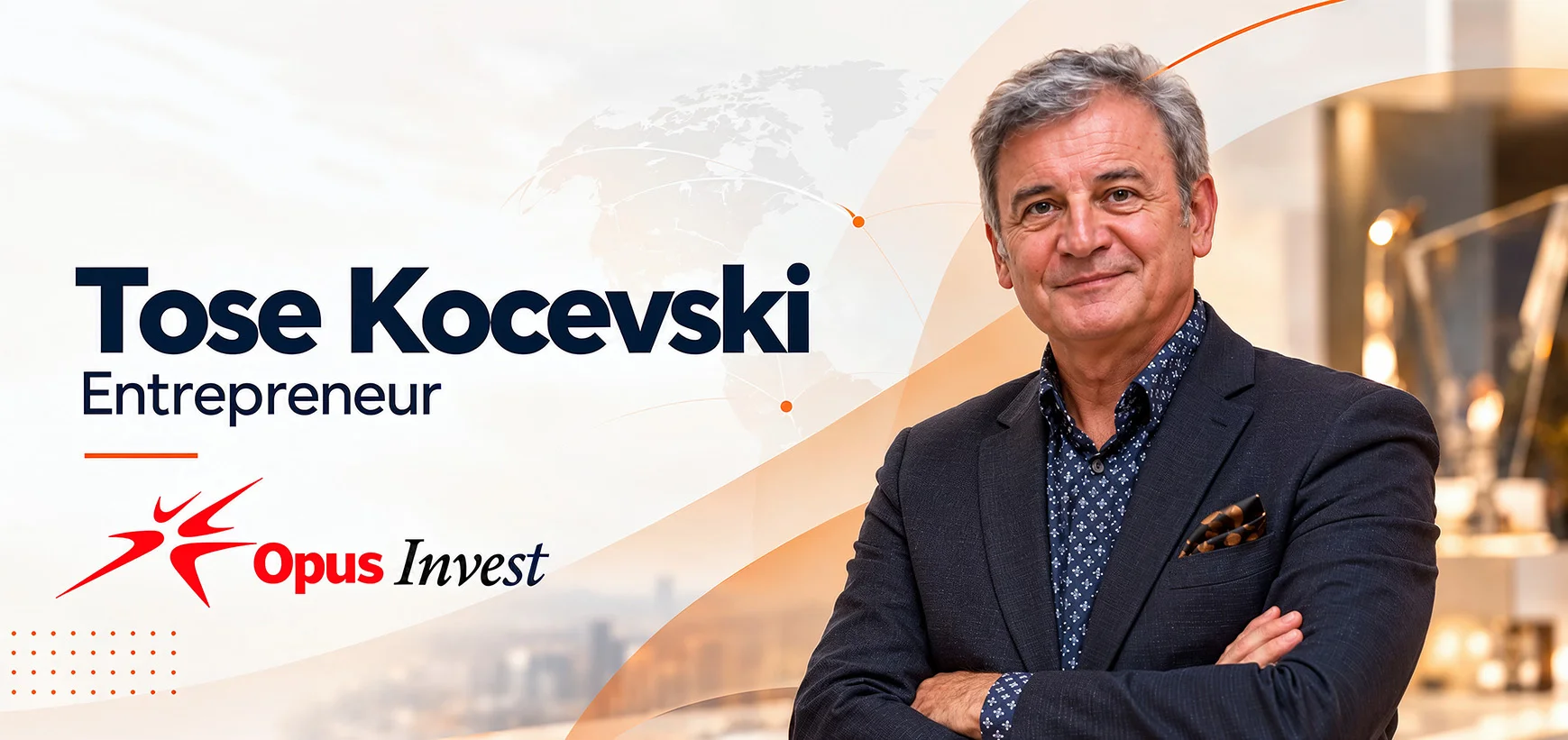
Tose Kocevski is an entrepreneur with more than 30 years of experience building businesses across technology, investments, media and services. His work has included developing companies, regional partnerships and teams of approximately 100 to 300 people serving clients across telecommunications, banking, retail and technology.
His business philosophy centres on execution, adaptability, customer understanding, financial discipline and continuous learning.


Connect with Tose Kocevski
Interested in working with or consulting with this expert? Submit your details below.