





- More Than 20 Years in Telecom Led to One Recurring Problem
- The Team Was Experienced. The Ownership Mindset Was Missing
- What Viktor Tells Entrepreneurs Now
- Viktor’s View of the Next Generation of Networks
- Leadership Means Seeing More Than Your Own Department
- What Viktor Risteski’s Founder Journey Really Shows
- About Viktor Risteski
Twenty years inside an industry gives you enough time to notice which problems keep coming back.
For Viktor Risteski, years spent working across telecommunications showed him that companies were not always struggling because the technology itself was too complicated. Often, the real frustration was simpler. A network problem appeared, several suppliers or internal teams were involved, and valuable time disappeared while people tried to determine who was responsible for solving it.
Viktor believed there was a better way to organise that relationship.
After more than two decades in telecommunications, mainly working with alternative telecom operators, he founded Prolink ICT DOOEL Skopje with the idea of bringing several traditionally separate ICT responsibilities under one roof.
The company would combine telecom services, system integration, implementation and system administration. Instead of clients calling one provider for connectivity, another for systems and someone else for administration, Prolink ICT would become the point of contact responsible for moving the problem toward a solution.
The idea was technically sound. The company was built quickly. Within four months, Prolink ICT had become operational with offices, people, hardware, software, operator licences, interconnections and teams covering technical, sales and administrative functions.
Then came the harder part.
Viktor discovered that building the infrastructure of a company was one challenge. Building a team that thought about the company with the same urgency as its founder was something entirely different.
That lesson would eventually change the way he approached hiring, sales, outsourcing and growth.
More Than 20 Years in Telecom Led to One Recurring Problem
Prolink ICT did not begin with Viktor trying to enter an unfamiliar industry. It came from years of working inside telecommunications and seeing how technology operations functioned from close range.
His experience had covered different telecom positions, primarily within alternative operators. During those years, the responsibilities surrounding telecommunications and IT were becoming broader. Companies needed connectivity, system administration, network design, implementation, hardware, software and increasingly more sophisticated technical support.
The problem was that these responsibilities were often fragmented.
When something stopped working, the customer could find itself between multiple technical parties. One provider might manage the connection, another the hardware, while internal administrators handled another part of the environment.
Before solving the technical problem, the organisation first had to answer another question: whose problem is it?
Viktor wanted to reduce that friction.
His concept for Prolink ICT was built around combining telecommunications services with system integration and administration so that clients could rely on one point of contact.
The business would not simply provide access or install equipment. It would take a broader role in keeping the client’s ICT environment functioning.
For Viktor, the benefit is straightforward. Companies should not have to lose time navigating responsibilities when an operational problem needs attention. That philosophy continues to sit at the centre of how he thinks about the company.
Building Prolink ICT in Four Months
Turning that idea into an operating telecommunications and ICT business required substantial upfront work.
Prolink ICT needed physical infrastructure, equipment, software, regulatory requirements, operator licences and interconnections. It also needed people who could sell, administer and technically deliver the services.
The initial investment was significant. Yet Viktor and his team managed to make the company fully operational in approximately four months.
A simplified view of what had to come together looks like this:
| Area | What Prolink ICT Needed |
| Business infrastructure | Offices and operational setup |
| Technology | Hardware and software |
| Telecommunications | Operator licences and interconnections |
| Technical delivery | People capable of implementing and supporting solutions |
| Sales | A team responsible for bringing business into a new company |
| Administration | People to manage the operational side of the business |
On paper, the foundation looked strong.
There was technical capability. There was a commercial team. There was an administrative structure. The necessary telecom infrastructure and licences were in place.
But having the structure of a company does not automatically create the behaviour needed to build one. That became Viktor’s first major founding lesson.
The Team Was Experienced. The Ownership Mindset Was Missing
Viktor initially placed considerable trust in the people around him.
He gave employees room to operate, make decisions and execute without constantly asking for approval. Because many had previous professional experience, he expected them to understand what needed to happen next.
That expectation turned out to be one of his early mistakes.
The issue was not simply whether people knew how to perform their individual roles. The problem was that Viktor expected them to recognise that they were working inside a newly created business where customers, revenue and momentum still had to be built.
There was no mature sales pipeline waiting for the team. There was no established company with years of organic business flowing through the door. The team had to create that activity. Viktor found himself repeatedly explaining that reality.
He did not expect instant results, but he did expect meaningful progress over time. He was prepared to support the team, yet he also needed people to take responsibility for producing outcomes.
For roughly a year, he continued trying to make the original structure work. Eventually, he realised that continuing to invest in the same setup simply because he had already invested heavily in it would not solve the problem. People had to go.
The Lesson Was Bigger Than Hiring
Looking back, Viktor does not describe the experience merely as hiring the wrong employees. The more important lesson was about assumptions.
A founder can see the business in one way and mistakenly assume everyone around them sees the same thing. They often do not.
A founder knows what is at stake financially. The founder sees the speed at which customers need to be acquired. They understand how much runway exists and what happens if targets are repeatedly missed.
An employee may understand the job without seeing the entire business context surrounding it. That distinction changed Viktor’s approach.
One of the lessons he now gives other entrepreneurs is not to build too much, too early.
- Start smaller.
- Find customers.
- See how the company develops.
- Understand what skills the business genuinely requires.
- Then hire people who match those requirements.
It is a very different approach from beginning with an organisational chart and trying to fill every box from day one. For Viktor, the right structure became something the business had to discover through experience.
Going Back to Selling Himself
Once the original team structure was dismantled, Viktor returned to one of the most fundamental parts of building any company: selling.
He began handling sales himself again.
At the same time, Prolink ICT moved toward outsourced technical support rather than maintaining the original internal structure. The result surprised him.
The outsourced technical model proved more efficient than the setup the company had previously maintained with its own employees. That experience reinforced another lesson: businesses should not become emotionally attached to one operating model.
An internal team is not automatically better simply because the employees sit inside the organisation. Outsourcing is not automatically better either.
As Prolink ICT developed, Viktor adjusted the model again. Full employment was eventually reinstated for technical support, while sales and lead generation increasingly relied on outsourced resources. This combination began producing better results.
The evolution can be viewed in three stages:
| Stage | Approach | What Viktor Learned |
| Initial launch | Full technical, sales and administrative workforce | Experience alone does not guarantee ownership or results |
| Restructuring | Viktor returned to sales and technical support was outsourced | A leaner external structure could be more efficient |
| Later development | Internal technical support rebuilt, sales and lead generation partly outsourced | Different functions may require different operating models |
What matters here is not which model was ultimately chosen. It is that Viktor was willing to change the model when the evidence showed that something was not working.
Start Small, Then Build the Team the Business Actually Needs
Viktor’s experience also challenges a familiar assumption about startup growth.
Founders sometimes feel pressure to look established as quickly as possible. A larger team, multiple departments and a complete organisational structure can make a new company appear more mature.
But appearance and operational necessity are not the same thing.
Viktor now believes founders should first acquire customers and understand how the business behaves in practice.
Only then can they properly answer questions such as:
- Which capabilities need to remain inside the company?
- Which functions can be outsourced?
- Where does the founder still need to be directly involved?
- Which roles create measurable value?
- What kind of people fit the way the company actually operates?
These questions become easier to answer after a business has customers, patterns and real operational experience.
Before that point, founders can find themselves hiring for the company they imagine instead of the company they currently have.
One Small Contract Showed How Trust Can Grow
One of the clearest examples of Prolink ICT’s approach to business came from a customer operating in the machine, steel and energy industry.
Viktor does not disclose the company’s name because of confidentiality, but describes it as a large business serving an impressive portfolio of domestic and international customers.
Prolink ICT approached the organisation without expecting a major contract. The initial opportunity was small. The company awarded Prolink ICT a contract for Dedicated Internet Access, or DIA.
There was no immediate network transformation project and no large multi-service relationship. Prolink ICT had simply been given a small opportunity to prove itself. What happened afterwards is more important than the size of the original contract.
Over time, Prolink ICT helped solve some of the customer’s internal network issues. The work gradually created trust. As confidence in the company increased, the relationship expanded.
Eventually, Prolink ICT was awarded a significantly broader mandate that included modernising the client’s network, updating hardware and software, managing devices, implementing a cybersecurity solution and acting as a technical consultant in relation to ISO standards.
A small access contract had turned into a much deeper ICT partnership.
What Viktor Tells Entrepreneurs Now
Viktor’s advice after building Prolink ICT is practical rather than motivational.
He encourages entrepreneurs to research decisions carefully, educate themselves and reduce risk wherever possible. That does not mean avoiding risk altogether. Starting a company makes that impossible.
It means understanding the difference between necessary risk and preventable risk. His own early experience provides the context.
Hiring a large team before the business had fully demonstrated what roles it needed created a cost that might have been reduced with a more gradual approach. That is why his recommendation to other founders begins with building smaller and learning faster.
Why Students Should Pay Attention to Smaller Companies
One of Viktor’s more interesting pieces of advice is directed toward students. He suggests following smaller companies because they can be an excellent source of real-world learning.
That may sound counterintuitive when large corporations dominate employer rankings and graduate recruitment campaigns. But smaller businesses often give people exposure to problems that are less neatly divided between departments.
A technical person may see sales.A salesperson may become more aware of operations. Junior employees can sometimes work much closer to company leadership, customers and decision-making. That exposure can help people understand how a business actually functions, not merely how one specific role functions inside a much larger organisation.
For someone early in their career, that experience can be valuable.
Viktor’s View of the Next Generation of Networks
When Viktor looks at where telecommunications and ICT are heading, AI sits near the centre of his expectations.
At a local level, he expects more companies to adopt technologies and practices that are currently not yet universally implemented. Globally, he expects AI-driven solutions to become common across sectors.
His prediction for networking is particularly specific. He believes network elements will increasingly be configured by AI agents. Networks themselves will gain stronger self-healing capabilities.
Cybersecurity will become a mainstream operational necessity rather than something treated as a specialist concern by only certain companies. If that direction continues, the role of a network administrator could change considerably.
Instead of spending large amounts of time manually detecting and correcting routine issues, technical professionals may increasingly supervise intelligent systems capable of identifying problems and responding automatically.
Human expertise would still matter, but its focus could move toward architecture, security, governance, strategy and complex exceptions. That makes continuous learning even more important.
Cybersecurity Is Becoming Basic Business Infrastructure
Viktor also expects cybersecurity to become far more deeply embedded into everyday business operations.
The reason is relatively simple.
As companies become more dependent on connected infrastructure, software, devices and automated systems, the consequences of security failures become harder to isolate.
A cybersecurity issue is no longer just an IT issue if it interrupts production, prevents employees from working or compromises business-critical information.
The line between operational infrastructure and security continues to narrow.
For an ICT company working across network management, hardware, software and administration, cybersecurity therefore becomes part of the wider responsibility rather than an isolated service.
Leadership Means Seeing More Than Your Own Department
Viktor’s experience has also shaped how he thinks about leadership.
He believes leaders need to understand the broader picture and then communicate that understanding in a way that makes sense to the individual groups responsible for executing it.
That second part is important.
A founder can understand the strategy perfectly and still fail if the rest of the organisation understands only individual tasks.
Viktor’s early team experience taught him not to assume alignment.
People may hear the same explanation and still interpret priorities differently.
Leadership therefore involves more than setting direction.
It involves making sure people understand their role in that direction.
Founders Also Need Boundaries
There is another part of Viktor’s advice that has little to do with networks or company structure. He believes people should make a clear distinction between work and private life.
Entrepreneurs in particular can easily fall into permanent availability. When you own the company, every problem can feel like your problem. Every client request can feel urgent. Every missed call can appear important.
Viktor’s recommendation is to learn to value your own time and avoid being constantly available. That boundary is not a rejection of responsibility. It is an acknowledgement that running a company should not require giving the company unrestricted access to every hour of your life.
Why Specialisation Still Matters
Technology careers often reward people who understand multiple disciplines. Viktor, however, warns against confusing broad awareness with shallow expertise.
In his view, it is better to become genuinely strong in one field than to know a little about many unrelated areas. That idea does not contradict his belief that leaders need to see the bigger picture.
A leader can understand how different parts of the company connect while still recognising where their deepest expertise lies. Specialisation creates depth. Perspective creates context. Strong professionals need to understand the difference.
What Viktor Risteski’s Founder Journey Really Shows
It would be easy to tell the Prolink ICT story as a straightforward technology entrepreneurship story. An experienced telecom professional saw an opportunity, started a company and expanded its services.
That version would miss the most useful part. The real story is about adjustment.
Viktor entered entrepreneurship with decades of industry experience, yet still discovered things that could only be learned by actually building the company.
He learned that experienced employees do not automatically behave like founders. He learned that building a complete team too quickly can create unnecessary risk. He learned that outsourced resources can sometimes outperform an internal structure. He learned that smaller client contracts can grow into substantial partnerships when trust is earned through execution. And he learned that knowing when to change direction can be just as important as knowing when to persist.
These are not abstract founder principles. They came from decisions that had real financial and operational consequences.
The Next Chapter for Prolink ICT
Prolink ICT was created to simplify a fragmented part of business technology by bringing telecom services, system integration, administration and implementation closer together.
The industry surrounding that idea is now changing quickly. Automation is becoming more sophisticated. AI is moving deeper into technical operations. Networks are becoming increasingly intelligent. Cybersecurity is becoming harder for companies to treat as optional.
For businesses operating in this environment, the ability to learn and adapt will matter as much as technical competence.
Viktor has already had to apply that principle to the company itself. The Prolink ICT operating model today is not identical to the model he imagined at the beginning. That is not a weakness in the founder story. It may be the strongest part of it.
The founder who spent more than 20 years understanding telecommunications eventually had to learn a different discipline: how to build an organisation around that knowledge. And the lesson he took from that process is simple enough to apply far beyond telecom.
Start carefully. Watch what works. Do not ignore the red flags. Build trust before chasing scale. Keep learning. And when reality gives you a better answer than the original plan, be prepared to change the plan.
About Viktor Risteski
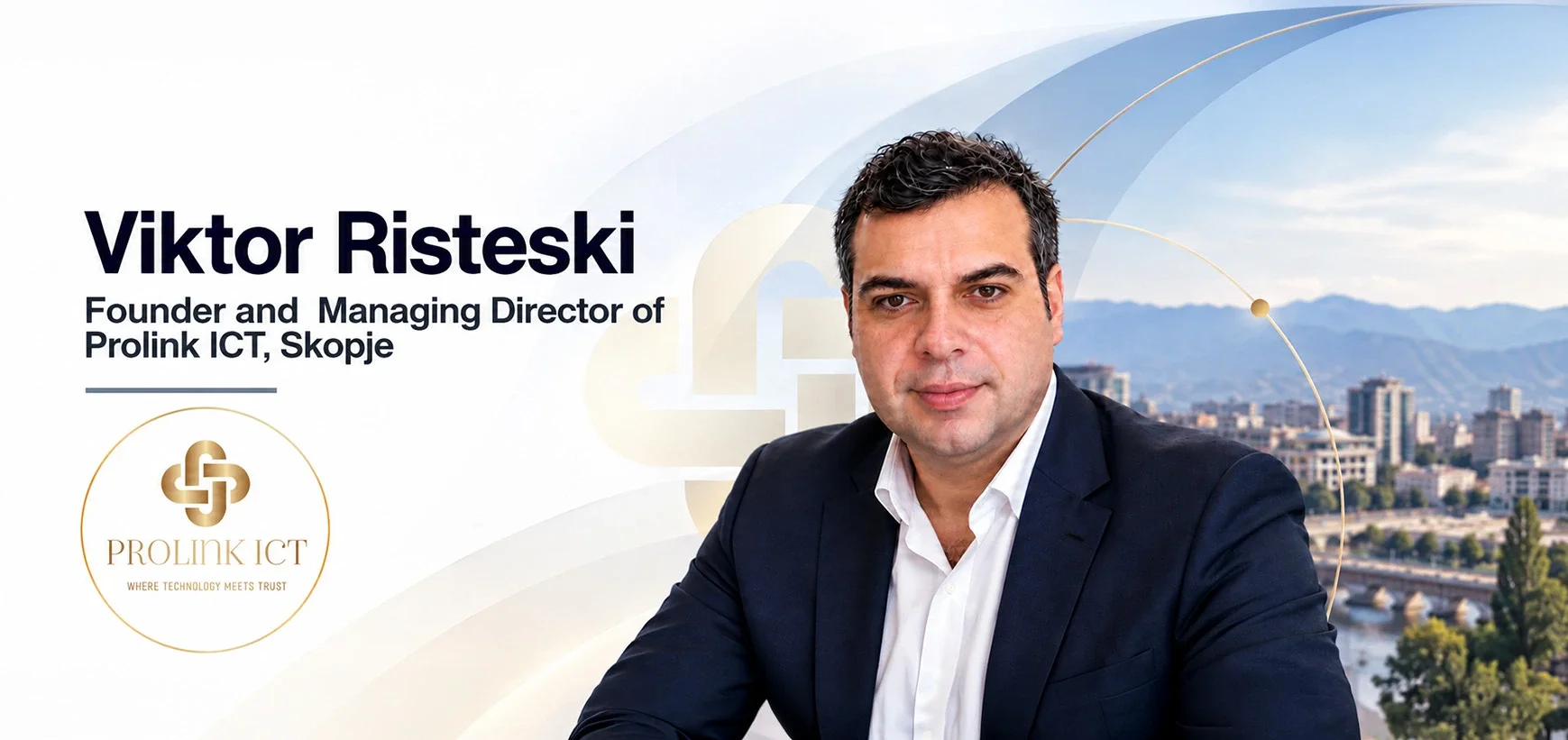
Viktor Risteski is the founder, owner and Managing Director of Prolink ICT DOOEL Skopje, a telecommunications and ICT company based in North Macedonia. With more than 20 years of experience across telecom roles, he founded Prolink ICT to bring telecom services, system integration, implementation and system administration under one coordinated service model.
His journey has been shaped by practical lessons around hiring, outsourcing, client trust and building the right team at the right stage. Today, he is also focused on the future of AI-driven networks, automation, self-healing infrastructure and cybersecurity.


Connect with Viktor Risteski
Interested in working with or consulting with this expert? Submit your details below.