





- Does Switzerland Have an Official Digital Nomad Visa?
- Switzerland Digital Nomad Visa: Legal Visa Alternatives for Freelancers & Remote Workers
- Switzerland Digital Nomad Visa: Swiss Tax Residency Laws & Financial Requirements
- Switzerland Digital Nomad Visa: Remote Work Logistics & Living in Switzerland
- Final Thoughts: Is Switzerland Right for Your Remote Working Life?
- FAQs About the Switzerland Digital Nomad Visa
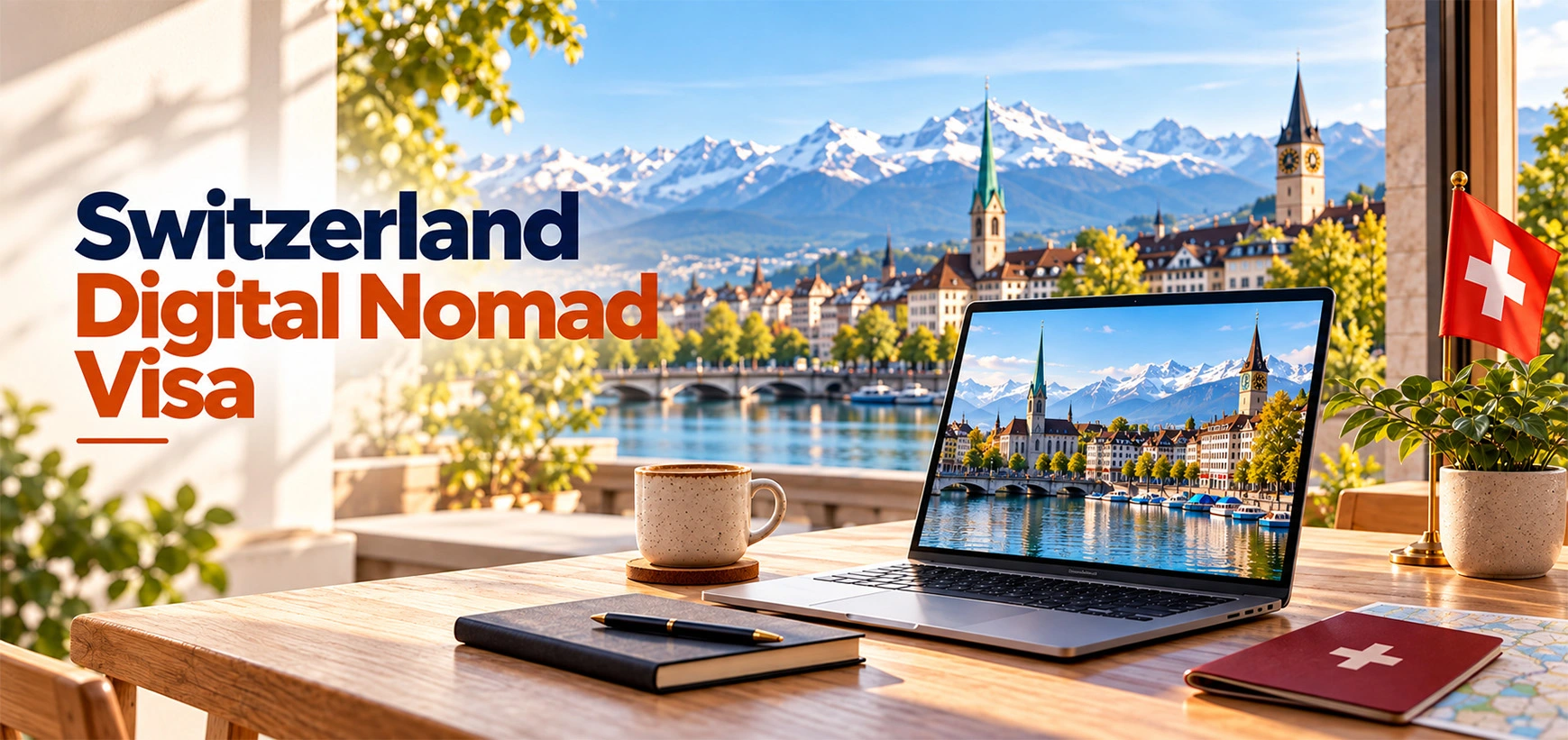
A morning on Lake Geneva. A productive afternoon in a Zurich co-working space. A weekend walking through the Alps rather than recovering from another exhausting commute.
Switzerland makes an appealing promise to remote professionals: a place where ambitious work and a rewarding life can comfortably coexist. But before choosing an apartment with a mountain view, there is a more practical question to answer.
Can you legally live in Switzerland while working remotely?
As of October 2026, Switzerland has no dedicated digital nomad visa. Remote professionals must qualify through existing immigration routes, with considerably different rules for EU/EFTA citizens and people from other countries. Switzerland’s official framework distinguishes entry, residence and permission to work; having one does not automatically provide the others.
This Kolekr Insights guide explains those distinctions, the residence options worth exploring, and the financial realities behind the Swiss lifestyle.
Does Switzerland Have an Official Digital Nomad Visa?
Switzerland does not currently offer a residence programme specifically designed for overseas employees or freelancers who want to bring their laptops and foreign income into the country.
There is consequently no official digital nomad application form, standard remote-worker income threshold or special nomad tax concession. Your route depends on your nationality, employment arrangement, intended activities and length of stay.
Switzerland belongs to the Schengen Area but is outside the European Union. Its agreements with the EU/EFTA give qualifying citizens access to residence and employment arrangements unavailable to most third-country nationals.
Switzerland Digital Nomad Visa: The Legal Reality for Non-EU/EFTA Nomads
For citizens of countries such as India, the United States or Australia, earning money abroad does not automatically create a right to work from Switzerland.
Swiss employment admission rules generally require authorisation for gainful activity. A foreign employer, overseas clients or payment into a foreign bank account should therefore never be treated as an automatic exemption. The relevant cantonal authority should assess your actual arrangement before you begin working.
For conventional employment, third-country admission generally focuses on highly qualified professionals. Employers must satisfy requirements including recruitment priority and appropriate employment conditions. Self-employment follows a separate assessment.
Consider an Indian consultant serving clients in London. A high income may make Switzerland financially achievable, but it does not establish immigration eligibility. The first task is to identify a lawful work and residence basis.
Switzerland Digital Nomad Visa- The 90-Day Tourist Schengen Rule: Can You Work on a Visit?
For many non-EU/EFTA visitors, the short-stay limit is 90 days in any rolling 180-day period across the Schengen Area. Time spent in France, Italy or Germany generally counts towards the same allowance. Moving between Schengen countries does not restart the clock.
That allowance governs short stays. It does not grant general permission to conduct your normal working life from Switzerland.
A holiday involving an occasional unexpected email and a planned two-month stay spent delivering client projects raises different factual questions. Avoid relying on informal claims that all online work is permitted because your customers are overseas. Describe your proposed activities to the canton and obtain guidance appropriate to your circumstances.
The practical distinction is simple: permission to visit and permission to work are separate questions.
Switzerland Digital Nomad Visa: Legal Visa Alternatives for Freelancers & Remote Workers
The most useful starting point is nationality, followed by whether you are genuinely self-employed, employed or economically inactive.
| Your circumstances | Route to investigate | Main issue |
| EU/EFTA citizen running a business | Self-employed residence | Evidence of genuine activity and financial sustainability |
| EU/EFTA citizen living without working | Residence without gainful activity | Sufficient resources and adequate insurance |
| Non-EU/EFTA founder | Entrepreneur/self-employment admission | Lasting economic benefit to Switzerland |
| Non-EU/EFTA employee | Employer-led work authorisation | Qualifications and labour-market admission requirements |
| Visitor planning ordinary remote work | Cantonal assessment before working | Tourist entry provides no automatic work entitlement |
These routes belong to Switzerland’s existing immigration framework; they are not versions of a digital nomad programme.
If you are considering Europe, our Germany digital nomad visa guide covers the residence options available to freelancers and remote professionals.
Switzerland Digital Nomad Visa: EU/EFTA Freedom of Movement & Financial Self-Sufficiency Route
EU/EFTA citizens generally have a more accessible starting point. Those genuinely establishing self-employment must register and provide evidence of their activity and ability to support themselves and their families.
Separately, economically inactive EU/EFTA citizens can qualify for residence with sufficient financial resources and adequate health and accident insurance. A qualifying B EU/EFTA permit is generally valid for five years.
However, the financially self-sufficient route should not be presented as a universal solution for active remote workers. Someone receiving investment income and someone working full-time for an overseas employer have different circumstances.
Explain your income sources and working arrangements accurately. Ask the canton how foreign employment will be classified and which registration, payroll or social-security obligations follow.
Switzerland Digital Nomad Visa: The Swiss Self-Employed Residence Permit & Cantonal Approvals
For non-EU/EFTA entrepreneurs, self-employment admission must demonstrate a lasting positive effect on the Swiss labour market and satisfy financial and operational requirements.
Official guidance calls for documents including a business plan, market analysis, workforce development, investment plans and turnover and profit forecasts. Relevant company records are also required.
This makes the route materially different from applying to live somewhere while continuing an existing freelance routine.
A credible application should explain:
- What the business will do in Switzerland.
- Why customers need its products or services.
- How it will finance operations.
- What investment, employment or other economic contribution it offers.
- Whether the founder has the experience to deliver the plan.
The canton matters because it participates in assessing applications. For third-country employment applications, the process includes cantonal review and federal approval where required. Allow time for that assessment before committing to a relocation date.
Switzerland Digital Nomad Visa: L Permit (Short-Term) vs. B Permit (Residence) for Contractors
L and B permits describe residence categories. Neither is a general-purpose contractor visa.
For EU/EFTA employees, the broad distinction relates to contract duration: shorter employment usually leads to an L permit, while employment lasting at least twelve months or indefinitely generally supports a B permit. Genuine self-employment can also support B EU/EFTA residence.
| Permit | General purpose | What contractors should check |
| L | Short-term residence | Approved activity, duration and any restrictions |
| B | Longer residence for an approved purpose | Whether employment or self-employment is authorised |
A service contract labelled “freelance” does not determine your legal classification. Authorities may examine how the relationship actually operates.
For third-country nationals, do not assume the EU/EFTA validity rules apply. Your approval basis and permit conditions determine what you can do.
Switzerland Digital Nomad Visa: Swiss Tax Residency Laws & Financial Requirements
Immigration eligibility answers whether you can live and work in Switzerland. Tax rules determine the financial consequences of doing so.
These systems operate separately. A short immigration stay is not necessarily a tax-free stay, and paying tax does not create permission to work.
Switzerland Digital Nomad Visa: The 30-Day and 90-Day Tax Rules for Foreign Income
Switzerland’s published tax-residence criteria include:
- Establishing a Swiss tax domicile through living there with the intention of remaining.
- Staying for at least 30 days while undertaking gainful activity.
- Staying for at least 90 days without gainful activity.
Brief interruptions do not necessarily break the relevant stay, and applicable double-taxation treaties remain important.
This is why the familiar “under 183 days means no tax” assumption is unreliable.
| Situation | Tax question to investigate |
| Working from Switzerland for an extended stay | Whether the 30-day residence criterion applies |
| Staying without working | Whether the 90-day criterion applies |
| Moving your home and personal life to Switzerland | Whether you establish domicile earlier |
| Keeping substantial ties to another country | How the relevant treaty resolves competing claims |
Swiss residents generally face taxation of worldwide income, with treaty relief and exceptions affecting particular income and assets. Income tax operates at federal, cantonal and municipal levels; cantonal and municipal wealth taxation also matters.
Before moving, assess your salary or business income, investments, overseas assets and existing tax residence. Founders should also consider whether managing their foreign company from Switzerland creates company-level exposure: effective management can affect corporate tax residence.
Switzerland Digital Nomad Visa: Mandatory Health Insurance Requirements & High Cost of Living Thresholds
People taking up residence generally must arrange Swiss compulsory health insurance within three months, unless an applicable exemption or international arrangement changes their position. Ordinary travel insurance should not be assumed to satisfy resident requirements.
Recent figures show why budgeting deserves serious attention:
| Indicator | Official figure | Planning implication |
| Swiss price level, 2024 | 158.8, with EU27 = 100 | Broad consumer prices were about 59% above the EU average |
| Dwelling vacancy rate, June 2026 | 0.93% | Housing availability remains tight |
| Announced average health premium, 2027 | CHF 412 monthly, up 5% | Include rising insurance costs in next year’s budget |
The price comparison is a national basket measure, not a prediction that every purchase costs 59% more. The insurance average covers the insured population and is not an individual adult quote.
If you want to know more about the cost of rent, groceries, transport and healthcare, then read our guide to the cost of living in Switzerland.
For initial planning, consider this illustrative monthly budget for one adult:
| Expense | Planning allowance in CHF |
| Housing and utilities | 1,600–2,800 |
| Groceries and household essentials | 450–700 |
| Basic health insurance | 350–650 |
| Transport | 100–250 |
| Coworking | 200–450 |
| Phone, leisure and miscellaneous spending | 250–500 |
| Total before tax | 2,950–5,350 |
These are editorial planning allowances, not official averages or permit thresholds. Replace them with current local quotations. Furnished accommodation, central locations and family needs can raise costs substantially.
Also budget for deposits, moving costs, medical cost-sharing and times of lower income.
Switzerland Digital Nomad Visa: Remote Work Logistics & Living in Switzerland
The success of the move depends no less on the everyday habits than on the decision of residence.
Choose a base around your working hours, language preferences and housing options. A beautiful address loses its appeal if you cannot take calls privately or your commute consumes the time you hoped to gain.
Switzerland Digital Nomad Visa: Finding Coworking Spaces, Long-Term Housing, and Managing Expenses
Start with the working environment. Before you buy a coworking membership, check out the call booths, meeting room charges, opening hours, internet reliability and cancellation terms.
The vacancy rate in Switzerland is 0.93% in June 2026, so the housing market is tight. But locally, the availability of housing units varies. Get documentation early and be flexible on neighbourhood and move-in date.
The logical order of searches is to establish legal residential eligibility, find temporary housing, and then search for potential longer-term housing options. Before paying for a longer stay, verify that the address is eligible for municipal registration.
For expenses, separate the must-haves from the lifestyle spending. Rent, insurance and tax provisions should be funded before weekend travel and restaurant budgets. If you earn in euros, pounds or rupees, test how exchange-rate movements would affect your monthly surplus.
A useful question is: Would this move still feel comfortable during your weakest earning month? Switzerland rewards financial stability more than optimistic forecasting.
Final Thoughts: Is Switzerland Right for Your Remote Working Life?
Switzerland can be a rewarding home for professionals whose immigration eligibility, income and working arrangements fit its rules.
The best first step is to establish your legal route, then compare locations using realistic housing, insurance and tax costs. Once those foundations are clear, the lifestyle decision becomes much easier.
At Kolekr Insights, we explore the practical questions behind working and building a life across Europe. For Switzerland, that means looking beyond the mountain-view promise and understanding what makes a move sustainable.
Get the basics right, and the scenery is something you can enjoy with confidence.
FAQs About the Switzerland Digital Nomad Visa
1. Is there a Switzerland digital nomad visa in 2026?
No. Switzerland doesn’t have a specific digital nomad program, but there are ways to get a residence and work permit. That depends on your nationality and situation.
2. Can Indian citizens work remotely from Switzerland on a tourist visa?
A tourist visa doesn’t automatically allow you to work remotely. Indian citizens are advised to check with the relevant cantonal authority for their intended activity and obtain any necessary work authorisation before commencing.
3. What is the minimum income requirement?
There is no official digital nomad income threshold because no such programme exists. Financial requirements depend on the residence route, household needs and the authority’s assessment.
4. Can EU citizens move to Switzerland as freelancers?
Generally, EU/EFTA citizens can pursue genuine self-employment, subject to registration, evidence of the activity and the ability to support themselves. Foreign-employer arrangements require their own assessment.
5. Does staying fewer than 183 days avoid Swiss tax?
No. Swiss domestic rules include domicile and the 30-day and 90-day residence criteria. 183 days is not a universal safe limit; treaty provisions may change the outcome.
6. Does another European digital nomad visa let me work in Switzerland?
It does not automatically confer Swiss work rights. A qualifying Schengen residence document may facilitate a short visit, while permission to work remains a separate matter.