





- Cost of Living in Germany: Quick Answer
- Cost of Living in Germany: Average Monthly Living Expenses for Expats & Students
- Cost of Living in Germany: Housing & Utility Expenses
- Cost of Living in Germany: Everyday Essentials & Lifestyle Expenses
- Cost of Living in Germany: Healthcare & Mandatory Insurance
- Smart Strategies to Reduce the Cost of Living in Germany
- How Does the Cost of Living in Germany Compare With Other European Countries?
- Is Germany Expensive to Live In?
- Frequently Asked Questions About the Cost of Living in Germany
Germany remains a favourable destination for many students, experts, entrepreneurs, and families because of its powerful economy, good infrastructure, top-notch universities, and high standard of living.
But what is the cost of living in Germany?
The answer depends heavily on where you live, your household size and your lifestyle.
A student sharing an apartment in Leipzig may live reasonably on around €1,000 a month, while a professional renting alone in Munich can easily spend €2,000 or more.
Housing remains the biggest variable.
According to Germany’s Federal Statistical Office, private households spent an average of €3,032 per month on consumer expenditure in its latest detailed household survey. Housing, energy and home maintenance alone accounted for €1,137.
Students usually operate on considerably smaller budgets. DAAD estimates that students in Germany generally require around €900–€1,200 per month, depending largely on their location and accommodation.
KOLEKR Insights is a platform that analyzes real business, economic and lifestyle data across Europe to help professionals, founders, international students and globally mobile individuals to make better-informed decisions. In this guide, we combine official German statistics, current market data and realistic household estimates to give you a clearer picture of the cost of living in Germany.
This guide breaks down the cost of living in Germany from rent and groceries to transport, utilities, health insurance and leisure—so you can build a realistic budget before moving.
Cost of Living in Germany: Quick Answer
For most people, the cost of living in Germany will depend primarily on rent and location.
| Profile | Practical Monthly Budget |
| Student | €900–€1,200 |
| Single professional | €1,500–€2,000+ |
| Single professional in Munich/Frankfurt | €1,800–€2,500+ |
| Couple | €2,400–€3,500+ |
| Family of four | €3,500–€5,000+ |
These are working planning ranges, not official minimums. The most recent comprehensive survey of household expenditure in Germany showed average monthly private consumption of €1,918 for a single-person household, €3,382 for two people and €4,599 for a four-person household.
KOLEKR Insights takeaway: Germany is not a one-price market. Where you live (and more specifically, how much you pay for housing) can affect your monthly budget much more than your day-to-day costs like groceries or transport.
Cost of Living in Germany: Average Monthly Living Expenses for Expats & Students
There is no single figure that represents every resident.
A practical monthly budget for a single adult in Germany in 2026 typically looks like this:
| Expense | Estimated Monthly Cost |
| Rent + basic housing costs | €650–€1,500+ |
| Groceries | €200–€350 |
| Electricity | €40–€90 |
| Internet + mobile | €30–€60 |
| Public transport | €63+ |
| Health insurance | Income-dependent |
| Rundfunkbeitrag | €18.36 per household |
| Leisure & dining | €100–€300+ |
| Indicative total | €1,200–€2,400+ |
These figures should be treated as planning ranges rather than fixed prices. Munich, Frankfurt, Stuttgart and central Berlin can be considerably more expensive than Leipzig, Dortmund or smaller German cities.
For students, DAAD currently advises budgeting approximately €900–€1,200 per month. Its published student expense data includes average rent and utilities of €410, food costs of €198 and approximately €100 for health-related expenses.
Cost of Living in Germany by Household Size: Monthly Budget Breakdown
Household size makes an enormous difference because couples and families can share rent, internet, utilities and the broadcasting contribution.
The latest detailed Destatis household-size data provides a useful benchmark:
| Household Size | Average Monthly Consumer Spending |
| 1 person | €1,918 |
| 2 people | €3,382 |
| 3 people | €4,081 |
| 4 people | €4,599 |
| 5+ people | €4,995 |
The data is from Germany’s Federal Statistical Office (Destatis) and is the average monthly private consumer spending from the 2023 Income and Expenditure Survey, the most recent full data set on household size.
A single-person household spent an average of €1,918 per month, compared with €3,382 for two people, €4,081 for three people and €4,599 for four people.
Housing is especially important for people who live alone. According to Destatis, single-person households had an average monthly expenditure of €817 on housing, energy and home maintenance, which was 42.6% of their private consumption expenditure.
Cost of Living in Germany: Monthly Rent for Popular Cities
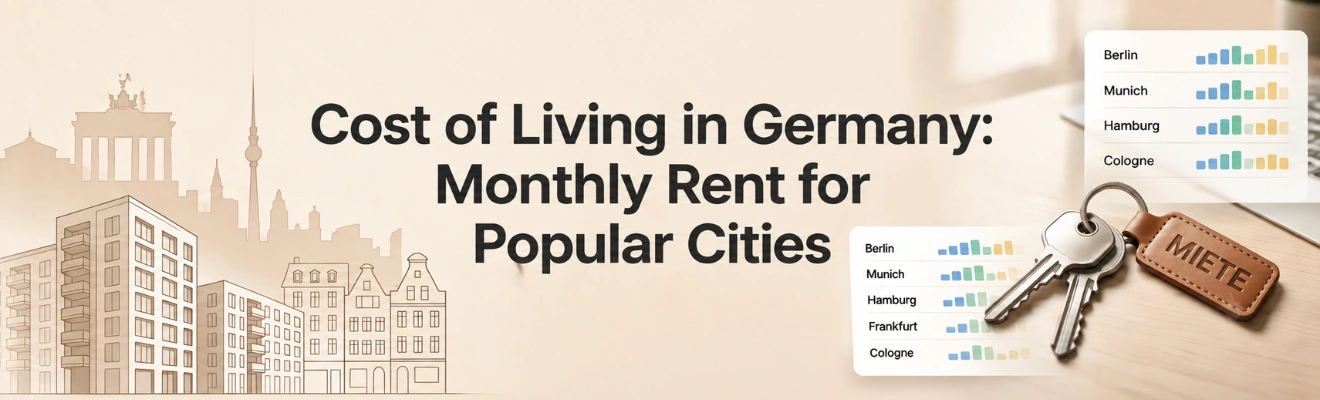
Where you live can change your budget by hundreds of euros every month.
ImmoScout24’s 2026 rental data illustrates the difference clearly. Average asking rents for apartments in Q2 2026 were approximately:
| City | Average Asking Rent per m² |
| Munich | €20.28 |
| Stuttgart | €15.00 |
| Frankfurt am Main | €14.99 |
| Cologne | €13.07 |
| Düsseldorf | €13.02 |
| Hamburg | €13.00 |
| Berlin | €12.72 |
| Essen | €9.22 |
| Leipzig | €9.09 |
| Dortmund | €8.84 |
| Germany average | €9.23 |
These numbers represent advertised rents and should not be confused with official local rent indices or the total Warmmiete paid by tenants.
For newcomers, however, asking rents matter because they more closely reflect what is available on the market today.
Munich therefore remains the city where housing is most likely to stretch your budget.
Leipzig, Dortmund and smaller regional cities can offer considerably better value.
Estimated Budget for the Cost of Living in Germany
Rent per square metre is useful, but newcomers usually want a more practical answer: how much should I budget each month?
Based on current housing levels and typical everyday expenses, KOLEKR Insights suggests using the following planning ranges for a single adult:
| City | Estimated Monthly Budget | Relative Cost |
| Munich | €1,900–€2,600+ | Very High |
| Frankfurt | €1,700–€2,300+ | High |
| Stuttgart | €1,650–€2,250+ | High |
| Berlin | €1,550–€2,200+ | High |
| Hamburg | €1,550–€2,150+ | High |
| Cologne | €1,500–€2,100+ | Moderate–High |
| Düsseldorf | €1,500–€2,100+ | Moderate–High |
| Leipzig | €1,200–€1,700+ | Moderate |
| Dortmund | €1,200–€1,650+ | Moderate |
Important: These are editorial estimates of cost of living, not government-defined cost-of-living numbers. The real costs depend very much on the size of the flat, the area, whether you share or not and on your own lifestyle.
This table is more helpful than just rent for someone moving to Germany because accommodation is only a fraction of the final monthly budget.
Cost of Living in Germany: Housing & Utility Expenses
For most households, accommodation will be the largest monthly expense.
Destatis data shows that housing, energy and dwelling maintenance represent the biggest single category of German household consumption.
Finding accommodation can also be challenging in popular cities, so new arrivals should budget not only for monthly rent but also for their deposit and initial furnishing expenses.
Cost of Living in Germany: Kaltmiete vs. Warmmiete
Two terms every newcomer should understand are Kaltmiete and Warmmiete.
Kaltmiete literally means “cold rent.” It is the basic amount paid to the landlord for using the property.
Warmmiete usually combines Kaltmiete with certain additional building and operating costs, known as Nebenkosten.
These can include items such as:
- Heating
- Water
- Waste collection
- Building maintenance
- Common-area cleaning
- Certain property operating costs
Electricity inside your apartment is frequently contracted and paid separately.
The Internet is normally separate as well.
Imagine an apartment advertised at:
Kaltmiete: €900
Nebenkosten: €250
Your Warmmiete would therefore be around €1,150, before separately billed costs such as electricity and internet.
Always check exactly what is included before signing a rental contract.
Cost of Living in Germany: Electricity, Heating, Water and Internet
Energy remains an important part of the German household budget.
The official Destatis data on household expenditure is a useful context for energy spending. Among households that reported their energy expense, the average monthly energy spend was around €219 per household and around €159 for single-person households.
According to the latest comprehensive expenditure data, single-person households spent on average about €66 per month on electricity alone. The actual 2026 bills can vary a lot depending on the tariff, consumption, efficiency of the flat and whether heating is included in the Nebenkosten of the property.
Of course, consumers who want to switch their energy suppliers can take advantage of lower prices.
The Bundesnetzagentur reported that modelled electricity prices for new customers were around 34.99 cents/kWh in June 2026, while existing-customer prices were approximately 34.90 cents/kWh.
That makes comparison shopping worthwhile.
The regulator estimated that a household consuming 3,500 kWh annually could save around €95 per year by switching electricity providers under its January 2026 assumptions.
For a typical renter, a sensible planning range might be:
| Utility | Typical Monthly Budget |
| Electricity | €40–€90 |
| Heating/water | Often partly included in Nebenkosten |
| Home internet | €25–€50 |
| Mobile phone | €10–€30 |
Actual consumption, apartment efficiency and contract type will determine your final bill.
Cost of Living in Germany: The Mandatory Rundfunkbeitrag
Germany has another household expense that frequently surprises newcomers: the Rundfunkbeitrag, or broadcasting contribution.
As of 2026, it is €18.36 per month per dwelling.
Importantly, the charge applies to the apartment rather than each resident. A couple, family or shared flat normally pays one contribution for the entire household.
That means four people sharing one apartment do not each pay €18.36.
They can split one household contribution between them.
Cost of Living in Germany: Everyday Essentials & Lifestyle Expenses
Once rent is covered, everyday spending in Germany can be relatively manageable, especially if you shop at discount supermarkets and use public transport.
But lifestyle choices matter a great deal.
Someone who cooks at home, cycles and uses the Deutschlandticket can spend substantially less than someone regularly eating out and maintaining a car.
Cost of Living in Germany: Grocery Costs & Supermarket Shopping
German grocery prices remain reasonable relative to wages in many regions, although food inflation over recent years has increased household bills.
Destatis household data shows average spending on food, beverages and tobacco of €436 per household per month. Single-person households averaged approximately €254.
Current crowdsourced national price data gives an idea of individual grocery prices:
| Grocery Item | Approximate Price |
| Milk, 1 litre | €1.17 |
| White bread, 500 g | €1.90 |
| Rice, 1 kg | €3.14 |
| Eggs, 12 | €3.40 |
For one adult cooking most meals at home, budgeting around €200–€350 per month for groceries is realistic.
A few simple habits can reduce this further.
Aldi, Lidl, Penny and Netto are usually useful for budget-focused shopping, while supermarket own-brand products can be considerably cheaper than branded alternatives.
Weekly meal planning also helps reduce food waste and impulse buying.
Cost of Living in Germany: Public Transportation vs. Owning a Car
In many of Germany’s large cities, public transport is good enough to live without a car.
The Deutschlandticket is one of the most important costs to know for 2026.
Since January 2026, it costs €63 per month and grants you access to eligible local and regional public transport throughout Germany.
For residents who regularly commute by bus, tram, U-Bahn, S-Bahn or regional train, this can make transport budgeting straightforward.
Owning a car is considerably more complicated.
You need to account for:
- Purchase or finance payments
- Insurance
- Fuel
- Vehicle tax
- Parking
- Maintenance
- TÜV inspections
- Tyres
- Unexpected repairs
Destatis household expenditure figures show average spending on transport of €361 per household per month, although this includes households with and without cars.
Unless your job or location makes a vehicle essential, living near reliable public transport can significantly reduce your cost of living in Germany.
Cost of Living in Germany: Dining, Fitness & Entertainment
Germany has something for almost any lifestyle budget.
Current nationwide price data suggests approximately:
- Inexpensive restaurant meal: €15
- Three-course meal for two at a mid-range restaurant: €65
- Cappuccino: €3.61
- Fast-food combo meal: €11
A person eating out once or twice a week might therefore comfortably allocate €100–€200 per month.
If you frequently visit restaurants, bars or cafés, that amount can rise quickly.
Fitness memberships vary widely—from inexpensive chains to premium wellness clubs—while many universities offer low-cost sports facilities for students.
DAAD also highlights that students often have the right to lower prices at museums, theatres, cinemas and cultural institutions.
Cost of Living in Germany: Healthcare & Mandatory Insurance
In Germany, health insurance is compulsory and should be part of any budget for a move.
The two main systems are:
Gesetzliche Krankenversicherung (GKV) – statutory/public insurance
Private Krankenversicherung (PKV) – private health insurance
Most employees are covered through the statutory system.
Cost of Living in Germany: Public vs. Private Health Insurance
The statutory health insurance contribution rate in Germany will be 14.6% of eligible gross income in 2026.
It is supplemented by a further contribution (Zusatzbeitrag). The average official supplementary contribution rate for 2026 is 2.9%, but individual insurers may set their own rates. As a rule, the employer pays half of the statutory contribution and half of the insurer-specific supplementary contribution.
There is also an income limit on the calculation of contributions. The statutory health insurance contributions for 2026 are based on a monthly income of €5,812.50 – or €69,750 a year.
For those employees who might want to opt for private insurance, another important number is the compulsory insurance threshold for 2026 (Jahresarbeitsentgeltgrenze). This is €77,400 per year for most employees.
These figures are important when calculating the real cost of living in Germany for expats, because healthcare is not just an optional monthly expense – it is a compulsory com
Private insurance works differently.
Premiums usually depend on factors such as:
- Age
- Selected benefits
- Deductible
- Insurer
- Policy structure
Higher earners, certain self-employed people and other eligible groups may choose private cover.
However, private insurance should not be selected purely because the initial monthly premium looks attractive. Also consider long-term costs, family coverage and the rules for returning to statutory insurance.
Smart Strategies to Reduce the Cost of Living in Germany
Germany is expensive, but your choice of city and lifestyle can make a bigger difference than national averages.
Here are some of the best ways to save money every month.
- Choose your city strategically.
A slightly higher salary in Munich may not compensate for dramatically higher housing costs. Compare disposable income after rent rather than salary alone. - Consider a WG.
A Wohngemeinschaft, or shared apartment, can dramatically reduce rent and utilities, particularly for students and young professionals. - Live outside the city centre.
Germany’s strong public transport network means living 20–30 minutes from central areas can sometimes save hundreds of euros each month. - Use the Deutschlandticket.
At €63 per month in 2026, it can be far cheaper than owning and operating a car. - Shop at discount supermarkets.
Build most of your grocery basket around Aldi, Lidl, Penny, Netto and supermarket own-brand products. - Compare electricity providers.
Energy tariffs vary. The Bundesnetzagentur’s 2026 analysis shows meaningful savings can still be available to customers who switch. - Split household costs.
Couples and flatmates can share internet, utilities and the €18.36 Rundfunkbeitrag. - Use student benefits.
Students should actively use university sports programmes, transport arrangements and cultural discounts.
How Does the Cost of Living in Germany Compare With Other European Countries?
Germany sits somewhere in the middle-to-upper range of Western European living costs.
| Country | General Cost Position | Key Budget Pressure |
| Germany | Moderate–High | Housing in major cities |
| Switzerland | Very High | Housing, food and services |
| Netherlands | High | Housing availability and rent |
| France | Moderate–High | Strong variation between Paris and regional cities |
| Austria | Moderate–High | Housing and everyday services |
| Poland | Lower | Major cities increasingly expensive |
| Czechia | Lower–Moderate | Prague considerably above national average |
If you are a professional thinking about a move, you should never compare only the country averages. If you’re thinking about Germany from a business point of view, our guide to the cost of doing business in Europe offers a more detailed comparison of taxes, labour costs and operating costs across European markets
Better to compare:
Net salary – housing – insurance – transport – essential spending = realistic disposable income.
This is especially true in Germany, where cities like Munich and Frankfurt offer attractive salary opportunities, but much of that benefit can be lost due to higher rents.
KOLEKR Insights recommendation: When comparing Germany to another European market, compare city-to-city and net disposable income comparisons rather than just comparing national cost-of-living rankings.
Is Germany Expensive to Live In?
Germany is not Europe’s cheapest destination, but it also isn’t among its most expensive when compared with countries such as Switzerland or Luxembourg.
The bigger question is which Germany you are moving to.
Living in a shared apartment in Leipzig is a completely different financial experience from renting a central one-bedroom apartment in Munich.
For a student, €900–€1,200 per month remains a useful planning benchmark.
For a working professional living alone, planning for approximately €1,500–€2,000+ provides more flexibility in many German cities.
In premium rental markets such as Munich, Frankfurt or Stuttgart, a comfortable budget may need to be substantially higher.
Families should calculate rent, childcare, insurance and transportation separately rather than relying on a simple per-person figure.
Ultimately, housing is the single variable most likely to determine your cost of living in Germany in 2026.
Secure affordable accommodation, use Germany’s public transport system effectively and manage recurring contracts carefully.The country has a great balance of cost of living, infrastructure, career opportunities and quality of life. If you’re an entrepreneur wanting to make Europe your home, see how Germany stacks up against other founder-friendly markets in our guide to the best countries in Europe to start a business.
Frequently Asked Questions About the Cost of Living in Germany
1. What is the average cost of living in Germany per month?
A single person should expect to budget around €1,200–€2,400+ per month for housing and general expenses, depending on the city and lifestyle. Official household spending numbers are higher because they are for average consumer spending for more broad-based types of households, not minimum budgets.
2. What is the cost of living in Germany for students?
DAAD estimates that students need, on average, about €900–€1,200 per month, depending mainly on accommodation and location.
3. Which German city has the highest living costs?
One reason why Munich is still one of Germany’s most expensive major cities is housing. According to ImmoScout24, the average asking rent was around €20.28 per square metre in Q2 2026 compared to a national average of €9.23.
4. How much is rent in Germany in 2026?
Average advertised flat rent in Germany was around €9.23 per square metre in Q2 2026. Large-city rents vary significantly. Munich was around €20.28 per square metre, Frankfurt €14.99 per square metre and Berlin €12.72 per square metre.
5. What is the difference between Kaltmiete and Warmmiete?
Kaltmiete is the net rent of the property. Warmmiete is rent plus some utilities, or Nebenkosten. These could be costs like heating and water. Electricity and internet are typically billed separately.
6. How much does public transport cost in Germany in 2026?
The Deutschlandticket costs €63 per month from January 2026 and covers eligible local and regional public transport.
7. How much is the TV licence fee in Germany?
The Rundfunkbeitrag is €18.36 per month per residence. It is normally levied only once on each household, no matter how many persons inhabit it.
8. Is healthcare free in Germany?
No. Health insurance is compulsory and is financed by insurance contributions. In 2026, the general contribution rate for statutory health insurance is 14.6% plus an insurer-specific supplementary contribution. These contributions are generally split between employees and employers.
9. Can you live in Germany on €1,000 per month?
It can be possible for a student or highly budget-conscious resident living in shared accommodation in an affordable city. It would be difficult for someone renting a private apartment in Munich, Frankfurt, Hamburg or many central areas of Berlin.
10. How much should an expat earn to live comfortably in Germany?
There is no universal salary because taxes, family size and rent vary. As a practical rule, calculate your expected net salary after tax, subtract Warmmiete and essential insurance, and check how much remains for food, transport, savings and leisure. In high-rent cities, housing costs should be assessed before accepting a salary offer.
11. Is Germany cheaper than the UK or Switzerland?
Germany can generally offer lower living costs than Switzerland, while comparisons with the UK depend heavily on the cities involved. Housing is usually the decisive factor—a Munich-versus-London comparison looks very different from Leipzig versus a smaller UK city.
Disclaimer: Prices and expenditure figures are based on the latest official and market data available as of September 2026. Actual costs vary according to city, household circumstances, property type, insurance provider and individual lifestyle.