





Switzerland often enters a founder’s shortlist for its reputation. The harder question is whether that reputation can translate into a profitable business.
For a specialist software company, medical technology venture or precision manufacturer, the answer may be yes. Access to research, experienced professionals and demanding customers can justify the cost of operating there. For a business competing mainly on price, the calculation can look very different.
Building a successful business in Switzerland starts with understanding that distinction. The country offers a strong setting for creating value, but incorporation alone will not deliver customers, funding or personal wealth.
This guide from Kolekr Insights examines the decisions that matter: choosing a company structure, meeting legal requirements, planning taxes, finding talent and expanding beyond the Swiss market.
What Makes Starting a Business in Switzerland So Lucrative for Founders?
Switzerland is attractive when your business benefits from expertise, reliability and intellectual property. Those advantages matter most when customers pay for a measurable outcome, such as better manufacturing accuracy, stronger financial controls or a product that solves a difficult technical problem.
Its business economy also extends well beyond multinational headquarters. According to SECO’s SME Portal, companies with fewer than 250 employees account for over 99% of commercial enterprises and approximately two-thirds of jobs. Smaller businesses are central to the market, creating potential customers, suppliers and partnership opportunities.
Recent indicators offer useful context, provided founders distinguish economic forecasts from completed results.
| Indicator | Reported figure | Period | What founders should take from it |
| Forecast Swiss economic growth, adjusted for sporting events | 1.7% | 2026 forecast published on 17 September 2026 | Plan around moderate growth rather than assuming a broad market boom |
| Forecast average annual inflation | 0.6% | 2026, same forecast | Relatively low inflation does not remove the need to manage salaries and overheads |
| Number of commercial SMEs | 624,219 | 2023 statistical year | Smaller companies form a substantial potential B2B customer base |
| Global Innovation Index position | 1st | 2025 edition | Switzerland has an established innovation ecosystem |
Before choosing Switzerland, see the best countries in Europe to start a business, our guide to compare locations on customers, talent, operating costs and growth potential.
Core Financial Advantages of Operating a Business in Switzerland
The financial case should begin with customers and margins.
A Swiss operation may help a business work more closely with specialist buyers, manage complex projects or develop proprietary technology. These benefits can support stronger pricing when the company can demonstrate quality and deliver consistently.
Consider two businesses. One sells an easily replaceable service and competes through low hourly rates. The other develops a specialist system that reduces costly errors for industrial customers. The second has a clearer route to absorbing Swiss operating costs.
For founders, the essential calculation is:
Expected revenue minus delivery costs, payroll, premises, compliance, financing and taxes.
Company profits and personal wealth also require separate planning. Money retained by a company is not the same as income available to its owner. Salary, distributions, reinvestment and an eventual sale each need to be considered within the founder’s wider circumstances.
How Pro-Innovation Regulations Accelerate Any Business in Switzerland
Innovation support can make a meaningful difference, but eligibility matters.
Innosuisse offers support for qualifying science-based start-ups preparing for their first market entry. Under its start-up innovation project programme, it can cover up to 70% of direct project costs, with the start-up contributing at least 30%. Applicants must meet requirements concerning innovation, scalability, Swiss presence and financial capacity.
This is particularly relevant to a company moving from validated technology towards a commercial product. A conventional agency or trading business should not assume it qualifies simply because it uses AI or other modern tools.
Founders should identify suitable programmes early, then build a credible application around customer demand, technical evidence and a realistic commercial plan. Funding can support execution; it cannot replace a viable business model.
Essential Steps to Establish and Register Your Business in Switzerland
Before registering a company, settle three questions: what activity it will perform, where its customers are and who will manage it.
A practical sequence is to:
- Validate demand and estimate operating cost
- Compare relevant cantons and municipalities
- Decide on type of ownership and legal form
- Confirm residence, work permission and local representation requirements
- Prepare incorporation documents and capital required
- Complete notarisation and commercial registration, if applicable
- Establish accounting, tax, payroll and insurance arrangements
- Obtain any necessary sector approvals before trading
Company registration and permission to work in Switzerland are separate issues. Resolving both early prevents an expensive mismatch between the company you establish and the activities you can personally undertake.
Choosing the Optimal Structure for Your Business in Switzerland
The right structure depends on liability, ownership, funding plans and administrative capacity.
| Structure | Capital requirement | Liability position | Typical use |
| Sole proprietorship | No statutory minimum capital | Owner generally bears personal liability | Independent professionals and smaller owner-operated activities |
| GmbH / Sàrl | CHF 20,000, fully paid | Generally limited to company assets, subject to legal exceptions and guarantees | Founder-led businesses and operating SMEs |
| AG / SA | CHF 100,000 subscribed capital; at least 20% per share paid, with a minimum total of CHF 50,000 | Generally limited to company assets, subject to legal exceptions and guarantees | Businesses planning investment, share transactions or larger ownership structures |
Official guidance specifies the capital and liability requirements for these structures.
A GmbH can suit a business with a small ownership group and an operational focus. An AG may suit a company expecting several investment rounds or more frequent changes in share ownership. Neither is automatically the best option for every foreign founder.
Also distinguish share capital from incorporation fees. Capital is contributed to the company; legal, banking, registration and advisory charges are separate expenses. The business will need working capital beyond the minimum legal requirement.
Meeting Mandatory Legal Compliance for a Business in Switzerland
Swiss GmbHs and AGs must be represented by at least one person resident in Switzerland. This requirement should be taken into account in the management and signing authority set-up.
Foreign founders also need to be aware of their immigration status. Admission for non-EU/EFTA nationals wishing to work as self-employed persons in Switzerland is conditional, inter alia, on a demonstrable long-term positive effect on the Swiss labour market. Authorities will consider the business plan, investment, recruitment intentions and financial projections.
The operating checklist should cover bookkeeping, corporate filings, employment arrangements, social insurance, data handling, contracts and any sector-specific licences.
VAT deserves particular attention. The standard Swiss rate is 8.1%. Registration generally becomes relevant when qualifying worldwide annual turnover reaches CHF 100,000, subject to the applicable rules and exemptions. Foreign businesses supplying Switzerland need to assess their position even without a Swiss subsidiary.
A useful approach is to assign each obligation to a named person before launch. Compliance becomes harder to manage when accounting, payroll and legal responsibilities are left between several providers.
Proven Strategies to Scale a High-Growth Business in Switzerland
Growth begins with a repeatable commercial offer.
Choose a customer segment where your expertise solves a costly problem. Then test whether buyers will pay enough to support delivery, customer acquisition and the overheads of a Swiss operation.
For example, an automation company may gain more traction by serving a specific manufacturing process than by presenting itself as a general technology provider. A narrow focus makes the sales proposition clearer and helps the team build reusable expertise.
Track a small set of useful measures: gross margin, customer acquisition cost, retention, payment collection and revenue concentration. Increasing sales while losing money on delivery is not a sustainable growth strategy.
Tax Optimization Frameworks Tailored for a Business in Switzerland
Tax planning should follow the business’s actual operations.
Location, management, employees and commercial activity all belong in the decision. Comparing headline rates without modelling the full operating cost can produce the wrong answer.
| Planning area | Question to resolve | Practical next step |
| Business location | Where will management and operations genuinely take place? | Compare suitable locations using a complete cost model |
| Cross-border activity | Could overseas activity create additional tax obligations? | Review contracts, staff locations and sales arrangements |
| Founder remuneration | How will the founder receive income? | Model company and personal consequences together |
| Intellectual property | Where is the IP developed, owned and used? | Document ownership and assess relevant treatment |
| Related-party transactions | Are group companies charging each other appropriately? | Establish defensible agreements and pricing |
| VAT | Where are supplies taxable and who must register? | Map transaction flows before launch |
More complex corporate arrangements will require a more detailed assessment, but the tax calculator of the Federal Tax Administration is a starting point for tax burden comparisons.
The big international groups must also take into account the OECD minimum tax framework.” In 2024, Switzerland implemented a domestic supplementary tax, followed by the income inclusion rule in 2025. The framework generally concerns multinational groups with annual global turnover of at least €750 million, targeting a 15% minimum effective tax rate. It is not a universal corporate rate for every Swiss SME.
Good planning makes the tax position clear and supportable. It also helps founders understand how much cash remains available for investment and distributions.
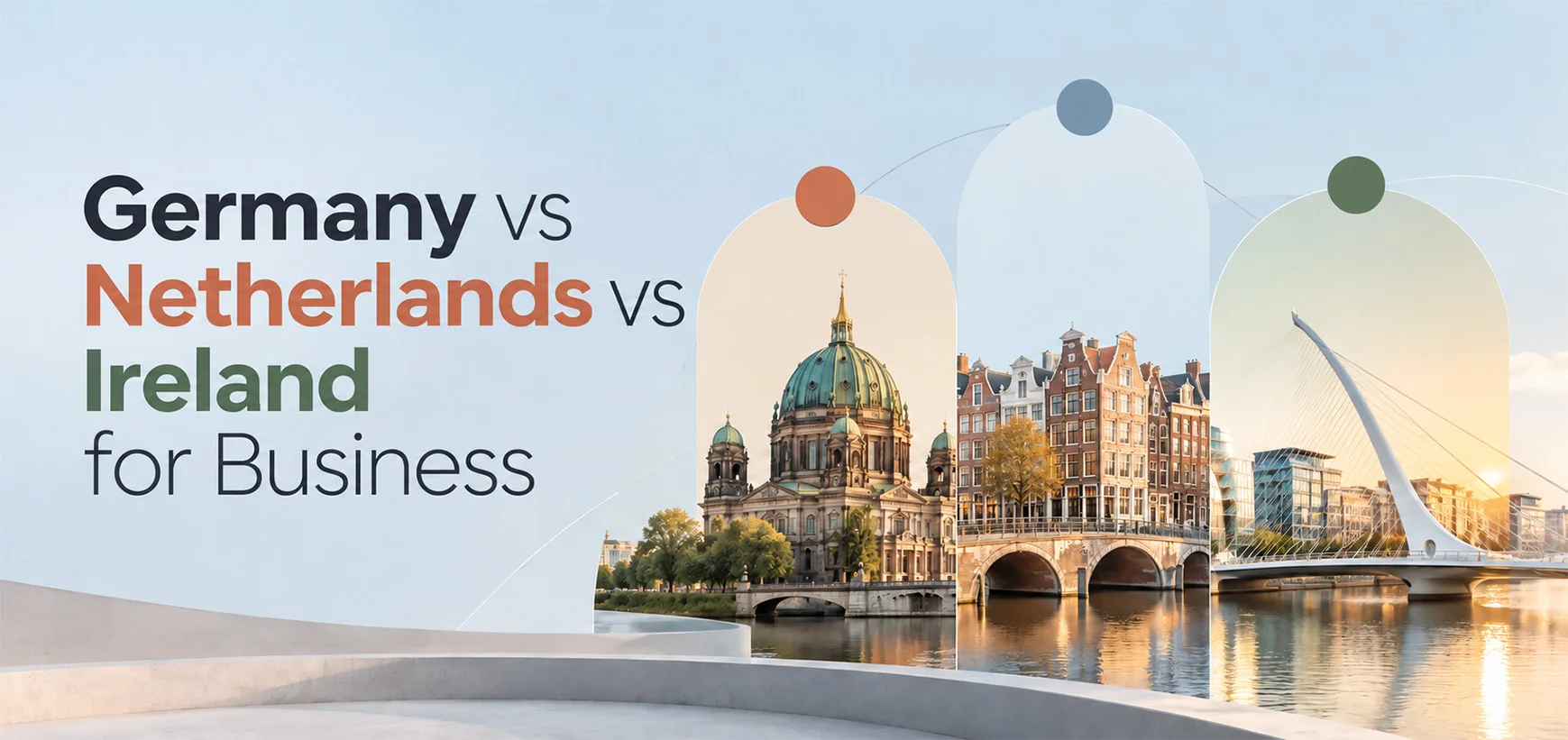
For business (including taxes, salaries and operating costs), we’ve undertaken a more holistic location comparison of Germany, the Netherlands and Ireland.
Accessing Elite European Capital and Talent for Your Business in Switzerland
A good location attracts attention but investors still want proof.
Prepare a funding case that explains the customer problem, market opportunity, revenue model, ownership of intellectual property and milestones the investment will finance. A tidy financial model is useful only when its assumptions withstand scrutiny.
Match the funding source to the stage of the business. Founder capital may support validation. An angel investor may support early commercial development.Venture capital requires a convincing path to large scale growth. Debt needs a credible case for repayment.
Hiring should be equally deliberate. Identify the roles that genuinely require a Swiss presence, then build the wider team around customer needs and operational efficiency. Cross-border teams can add capacity, but contracts, payroll, tax and work-permission questions must be resolved.
The aim is to create a capable team without adding fixed costs faster than revenue can support them.
How to Navigate Strategic Market Expansion for a Business in Switzerland
Switzerland can provide a base for international operations, but each destination market still requires its own entry plan.
The country is not an EU member state. Founders moving goods between Switzerland and the EU must account for customs procedures rather than treating the trade as movement within the EU customs union.
Expansion should therefore begin with a country-level assessment:
| Area | Decision before expansion |
| Customer demand | Is there evidence that buyers need the offer? |
| Product requirements | Are local approvals, standards or adaptations necessary? |
| Sales channel | Will direct sales, an agent or a distributor work best? |
| Tax and invoicing | What registrations and transaction rules apply? |
| Delivery | Who handles transport, customs, returns and service? |
| Language | Can customers buy and receive support in their preferred language? |
Begin with one market where the business has a distinct edge. Test sales, fulfilment and support before committing to several countries at once.
Key Risk Mitigation Protocols Every Business in Switzerland Must Follow
The risks worth managing are often ordinary: a delayed payment, one large customer leaving or a hire that arrives before there is enough work.
| Risk | Why it matters | Practical response |
| Currency movements | Overseas revenue may fluctuate against CHF costs | Set a currency policy and review exposure |
| High fixed costs | Payroll and premises can reduce flexibility | Hire against validated demand and defined milestones |
| Customer concentration | Losing one account can disrupt cash flow | Set concentration limits and broaden the pipeline |
| Slow payments | Reported revenue may not translate into available cash | Use payment schedules and active credit control |
| Regulatory gaps | Missing approvals can delay trading | Review requirements before launching an activity |
| Cyber incidents | Disruption can affect customers and operations | Maintain access controls, backups and incident procedures |
Create a negative forecast as well as the main strategy. Analyse the impact of long sales cycles, slow payments, or higher delivery costs.
That exercise helps determine how much funding the business actually needs and which commitments can wait.
Accelerate Market Entry and Growth With Kolekr Insights Business in Switzerland
A successful Swiss business begins with a clear reason to operate there.
That reason might be proximity to specialist customers, access to research, a stronger technical team or the needs of an existing international operation. It should be specific enough to justify the additional cost and complexity.
Kolekr Insights helps founders explore these decisions through business guides, market analysis and founder stories across Europe and the Balkans. Comparing Switzerland with other locations can clarify where to establish a company, recruit a team and build commercial partnerships.
Before committing, prepare a one-page investment case covering your target customer, proposed structure, operating location, first-year budget and route to revenue. If those decisions hold together, incorporation becomes part of a credible growth plan.
FAQs About Starting and Growing a Business in Switzerland
1. Can a foreigner start a business in Switzerland?
Foreign founders can establish Swiss companies, subject to the relevant requirements. Ownership, local representation and permission to live or work in Switzerland must be assessed separately. GmbHs and AGs must have a local representative.
2. How much capital is needed to start a business in Switzerland?
A GmbH requires a fully paid share capital of CHF 20,000. To be designated as an AG, a minimum subscribed capital of CHF 100,000 (with a minimum of 20 % per share paid) and a minimum paid-in amount of CHF 50,000 are required. Operating reserves and formation costs are additional.
3. Does opening a Swiss company give me residency?
No. Establishing a business does not automatically entitle to residence or employment authorisation. The right immigration pathway will depend on the individual’s nationality and circumstances. Non-EU/EFTA self-employment applications involve economic-interest and other requirements.
4. When does a business in Switzerland need VAT registration?
The general threshold is CHF 100,000 in qualifying worldwide annual turnover, subject to the relevant rules and exemptions. The standard rate is 8.1%. The treatment of specific supplies should be checked before invoicing.
5. Can a Swiss start-up receive innovation funding?
Eligible science-based start-ups may apply to Innosuisse programmes. Its start-up innovation project programme can cover up to 70% of direct project costs, subject to assessment and programme conditions. Approval is not automatic.
6. Can a Swiss company sell across the EU?
A Swiss company can pursue EU customers, but incorporation does not remove destination-market requirements. Goods may involve customs procedures, while tax, product compliance and other obligations depend on the activity and market.
7. Is Switzerland suitable for a small business?
It can be, when customers value the business’s expertise enough to support its operating costs. A founder should test margins, demand and cash requirements before choosing the location. Switzerland’s large SME sector shows that the market is not reserved for multinational companies.