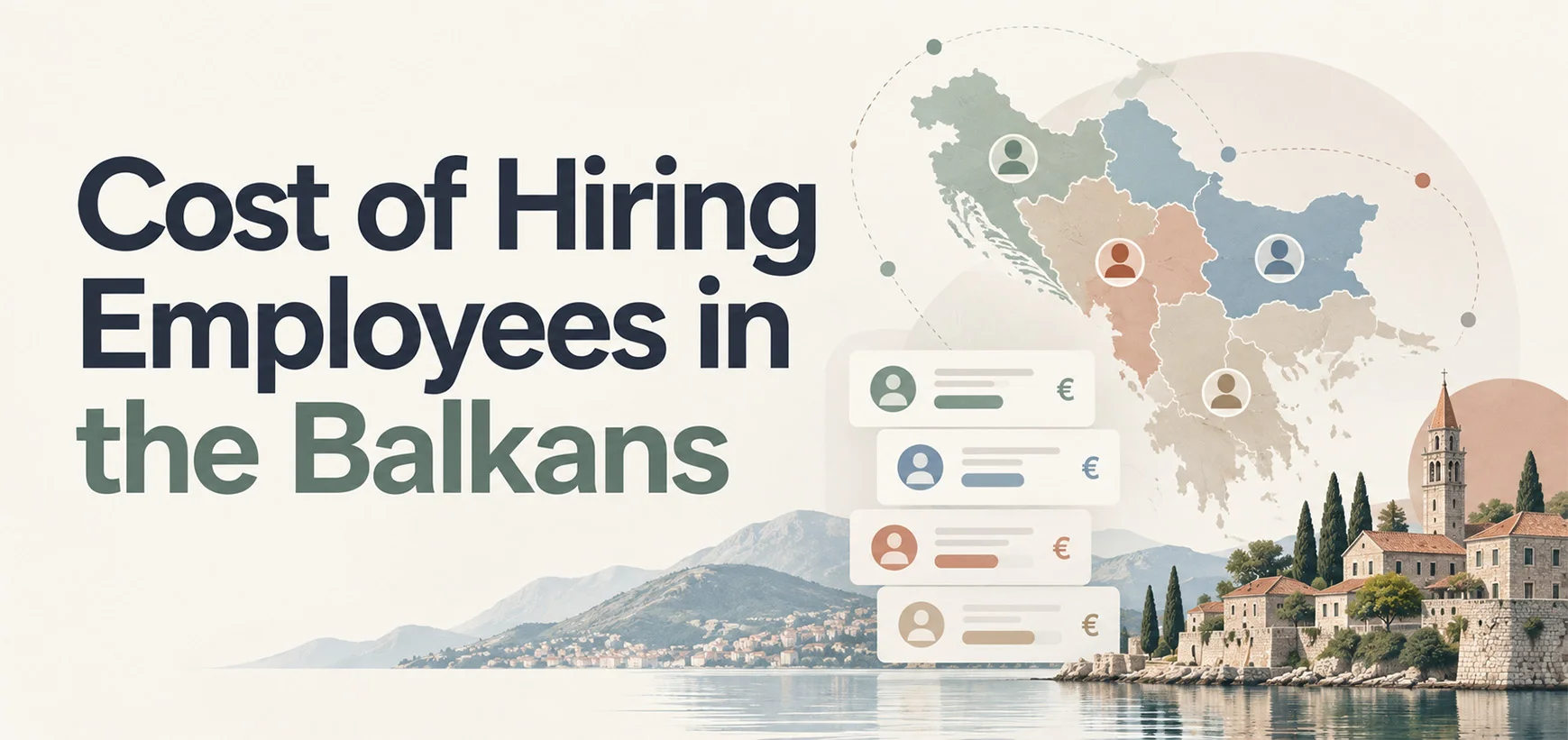






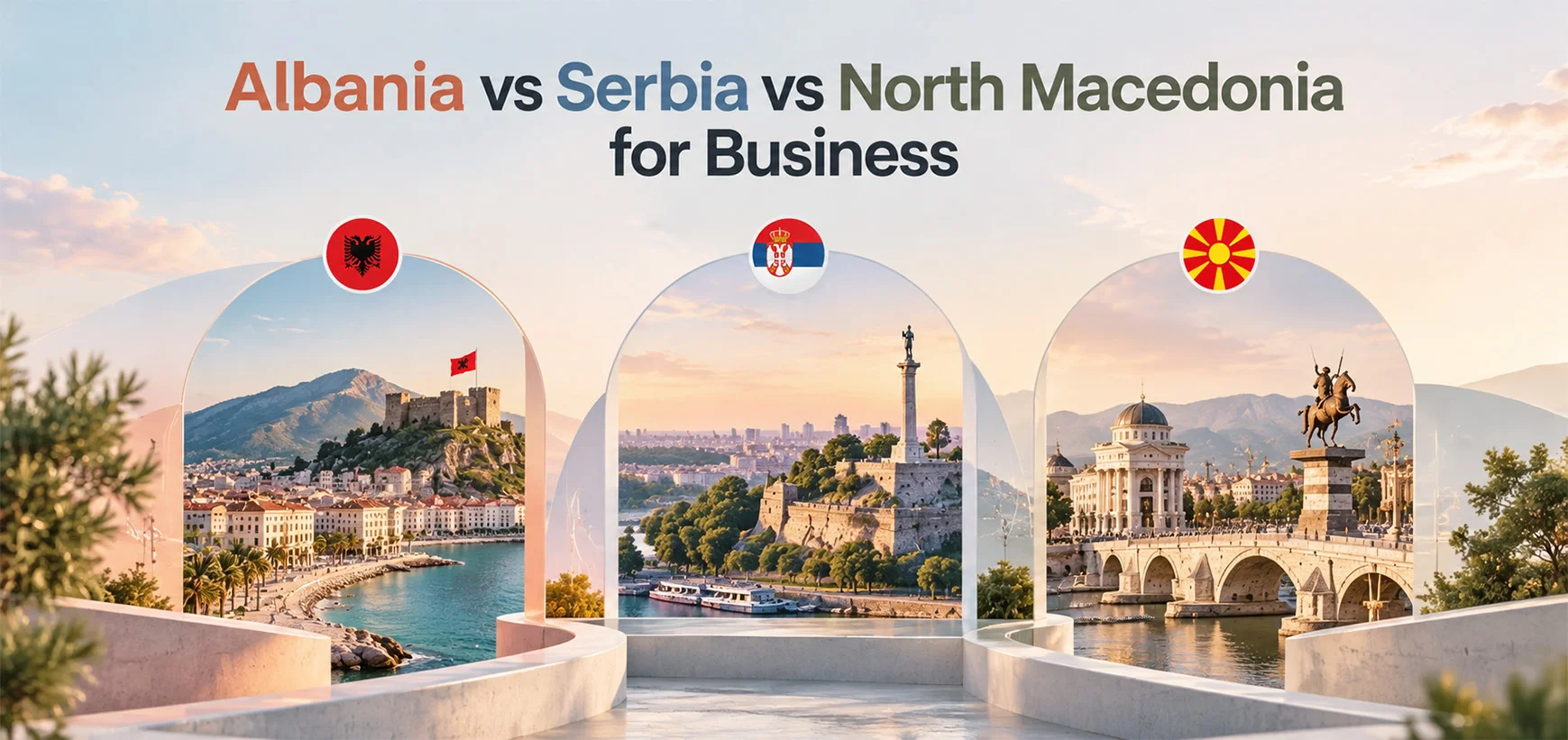
- Albania vs Serbia vs North Macedonia: Key Business Costs
- If You Only Have 30 Seconds
- What Would a 20-Person Team Cost?
- Albania: Best for Lean Service Economics
- Serbia: Pay More, Get More Scale
- North Macedonia: Strongest Headline Tax Case
- What About Internet and Everyday Running Costs?
- Which Country Fits Which Business?
- Albania, Serbia or North Macedonia: Which Should You Choose?
Which Balkan market gives founders the best balance of payroll, tax, workspace, talent and room to grow?
If you are considering the Western Balkans for a new company, regional office or delivery team, Albania, Serbia and North Macedonia can all look attractive. Corporate tax rates are competitive, wages remain below many Western European markets, and each country offers relatively easy access to the wider European region.
The similarities end quickly once you start building a real operating budget.
Albania offers the lowest indicative wage base in this comparison. Serbia is more expensive but offers a significantly larger business and hiring market. North Macedonia stands out with a 10% corporate income tax rate and a lean cost structure.
The right choice therefore depends less on finding the cheapest country and more on understanding what you receive for every euro you spend.
Albania vs Serbia vs North Macedonia: Key Business Costs
| Business Cost | 🇦🇱 Albania | 🇷🇸 Serbia | 🇲🇰 North Macedonia |
| Corporate income tax | 15% | 15% | 10% |
| Approx. gross wage / month | ~€895* | ~€1,450* | ~€1,050* |
| Approx. gross wage / hour | ~€5.1* | ~€8.4* | ~€6.1* |
| Employer social contributions | 16.7% employer-side | 15.15% employer-side | 28% compulsory contributions from gross salary† |
| Current coworking example | ~€170/month | ~€240/month | ~€145/month |
| Private office example | ~€700/month | ~€700/month | ~€299–399/month |
| LLC minimum capital | Low / structure-dependent | RSD 100, under €1 | €5,000 |
| EU member | No | No | No |
| Best fit | Services, tourism, outsourcing | Tech, engineering, scale | Manufacturing, lean exports |
*Gross-wage figures are approximate euro equivalents of official national wage statistics, not complete employer labour costs.
†North Macedonia’s system is structured differently from Albania and Serbia. Employers calculate and withhold compulsory contributions from gross salary rather than simply adding a 28% employer charge. PwC lists 18.8% pension, 7.5% health, 1.2% employment insurance and 0.5% additional health insurance. (PwC Tax Summaries)
Albanian employers contribute 16.7% on behalf of employees, comprising 15% for social insurance and 1.7% for health insurance. Serbia’s employer-side social-security burden is 15.15%, made up of 10% pension and disability insurance and 5.15% health insurance. (PwC Tax Summaries)
If You Only Have 30 Seconds
| Your Main Priority | Look at First |
| Lowest corporate tax | 🇲🇰 North Macedonia |
| Lowest indicative payroll | 🇦🇱 Albania |
| Largest labour and business market | 🇷🇸 Serbia |
| Technology/engineering | 🇷🇸 Serbia |
| Tourism/hospitality | 🇦🇱 Albania |
| Lean export operation | 🇲🇰 North Macedonia |
| Customer support/services | 🇦🇱 Albania |
| Building a much larger team | 🇷🇸 Serbia |
There is no universal winner. A 10-person agency, a 100-person software company and a manufacturing operation need very different things from a location.
What Would a 20-Person Team Cost?
Payroll is usually the first number founders should model because it compounds every month.
Using national average gross wages simply as an illustration:
| Country | Gross Wage / Employee | 20-Person Gross Payroll / Month | Gross Payroll / Year |
| 🇦🇱 Albania | ~€895 | ~€17,900 | ~€214,800 |
| 🇲🇰 North Macedonia | ~€1,050 | ~€21,000 | ~€252,000 |
| 🇷🇸 Serbia | ~€1,450 | ~€29,000 | ~€348,000 |
These figures are not hiring quotations. A software engineer, multilingual salesperson or experienced manager can earn substantially more than the national average.
They do, however, reveal the broader cost difference. On this simplified basis, a 20-person team in Serbia carries roughly €133,000 more annual gross payroll than the same headcount at Albania’s national-average wage level.
That saving only matters if Albania also has the people your company needs.
Albania: Best for Lean Service Economics
Albania becomes particularly interesting when a business earns revenue internationally while maintaining a local operating team. The standard corporate income tax rate is 15%, and employers currently contribute 16.7% in social and health contributions, subject to the applicable contribution bases. (PwC Tax Summaries)
For founders, the attraction is strongest in businesses where payroll matters more than domestic market size. Digital agencies, customer support, outsourcing, professional services and tourism are obvious examples.
Workspace can also be relatively accessible. One current Tirana coworking provider lists shared-space membership from €170 per month and private offices from €700 per month, including workplace amenities and Wi-Fi. These are individual market examples rather than city-wide averages. (Innospace Tirana)
Albania’s National Business Center now handles business registration through increasingly digital processes, including online services connected with the commercial register and beneficial-owner registration. (QKB)
The harder number to standardise is company formation cost. Translation, notarisation, foreign-founder documentation and professional assistance can change the bill substantially, so founders should obtain a local quotation rather than rely on a single packaged “Albania incorporation cost”.
Albania is strongest when: the company is service-led, international revenue matters more than the local consumer market, and keeping the early cost base lean is important.
Those founders who wish to incorporate locally may also check our comprehensive guide to company formation in Albania.
Serbia: Pay More, Get More Scale
Serbia costs more on average, but its business case is different.
The standard corporate income tax rate is 15%, while employer social-security contributions total 15.15%. (PwC Tax Summaries)
The higher wage base can be justified for businesses that need a deeper pool of developers, engineers, managers and other specialist employees. Serbia’s value is therefore less about being the cheapest Balkan location and more about balancing cost with the ability to scale.
Company formation is also inexpensive from a capital perspective. A Serbian limited liability company can be formed with minimum share capital of only RSD 100, effectively less than €1. LLC registration is handled electronically through the Serbian Business Registers Agency. (Welcome to Serbia)
For flexible workspace, current Belgrade listings show coworking around €240 per month for a flexible desk, with dedicated desks around €270 and private-office options around €700, depending on the provider and location. (workin.space WEBSITE)
A 2026 market guide estimates that combining a virtual office with basic accounting can start around €200–300 per month for a small company, although actual bookkeeping costs depend heavily on transactions, VAT, payroll and reporting requirements. (Jarnias Cyril)
Serbia is strongest when: the company needs specialist talent, expects headcount to grow substantially, or values a larger regional customer and supplier market.
For details of incorporation and costs, you can have a glance over the company formation in Serbia guide.
North Macedonia: Strongest Headline Tax Case
North Macedonia immediately stands out with a 10% corporate income tax rate, the lowest of the three countries in this comparison. (PwC Tax Summaries)
Its payroll system needs careful reading. Compulsory social contributions total 28% of gross salary, but unlike a simple employer-side surcharge, employers calculate, withhold and remit those contributions from the employee’s gross salary. (PwC Tax Summaries)
North Macedonia also has a much larger minimum-capital requirement than Serbia. Invest North Macedonia states that a standard limited liability company requires €5,000 in minimum share capital. Its one-stop-shop registration system can process company registration quickly, with the investment agency describing registration as possible within hours when documentation is ready. (Invest North Macedonia)
Workspace can still be inexpensive. Coffice in Skopje currently lists monthly coworking at €145, while another current provider advertises private offices around €299–399 per month. (Coffice)
For ongoing administration, market estimates put basic accounting anywhere from roughly €100 to €500 per month, depending on company size, transaction volume and complexity. This should be treated as a budgeting range rather than a regulated national tariff. (Jarnias Cyril)
North Macedonia is strongest when low corporate taxation, lean operations and export-oriented activity matter more than having the largest possible domestic market.
What About Internet and Everyday Running Costs?
Internet matters operationally, but for most small office-based companies it is unlikely to decide between Tirana, Belgrade and Skopje.
Many coworking packages already include high-speed Wi-Fi, which makes them useful for a founder testing a market before committing to a traditional lease. Tirana’s Innospace explicitly includes high-speed Wi-Fi in its plans, while current Skopje coworking providers do the same. (Innospace Tirana)
Dedicated business connectivity is a different product. Prices can rise substantially depending on guaranteed bandwidth, static IPs, service-level agreements and redundancy. For example, an enterprise provider in Albania lists dedicated 100 Mbps connectivity at several hundred euros per month, illustrating why a basic broadband package should not be compared with a dedicated enterprise circuit. (Cogent Communications)
For an SME, I would therefore budget for internet after deciding whether the business needs a coworking desk, normal commercial broadband or enterprise-grade connectivity.
The Costs Founders Often Forget
The incorporation fee is rarely what makes or breaks a location decision. Recurring expenses do.
Before choosing a country, budget for:
- Employer social contributions
- Accounting and payroll administration
- Registered office
- Coworking or commercial rent
- Internet and telecoms
- Banking and payment fees
- Legal and compliance support
- Recruitment
- Employee benefits
- VAT and sector-specific compliance
- Travel to customers
- Translation and document legalisation for foreign founders
A market can look inexpensive until the company begins adding employees, accountants, office space and compliance.
That is why comparing monthly operating cost is more useful than comparing a one-off registration fee.
Which Country Fits Which Business?
| Business Type | Best Starting Point | Why |
| Digital agency | 🇦🇱 Albania | Lean payroll and service economics |
| Software / product team | 🇷🇸 Serbia | Talent depth and scaling potential |
| Customer support / BPO | 🇦🇱 Albania | Lower indicative wage base |
| Tourism/hospitality | 🇦🇱 Albania | Strong sector fit |
| Engineering | 🇷🇸 Serbia | Larger specialist market |
| Manufacturing/export | 🇲🇰 North Macedonia | 10% tax + export orientation |
| Larger regional operation | 🇷🇸 Serbia | Greater market scale |
| Lean international business | 🇲🇰 North Macedonia / 🇦🇱 Albania | Different tax-versus-payroll advantages |
These are KOLEKR editorial starting points, not investment rankings.
Albania, Serbia or North Macedonia: Which Should You Choose?
Choose Albania for lean service economics. If the business sells internationally, employs a relatively small or medium-sized team and does not depend heavily on the local consumer market, its lower indicative wage base can make a meaningful difference.
Choose Serbia when scale matters more. Payroll is higher, but technology, engineering, specialist recruitment and the larger business market can justify that premium.
Choose North Macedonia when tax and a lean export structure are the priority. Its 10% corporate tax rate gives it the clearest headline tax advantage, although founders need to account for the €5,000 LLC capital requirement and the structure of payroll contributions.
The real choice is therefore not:
Which Balkan country is cheapest?
It is whether your company needs lower payroll, greater talent depth or a lower tax burden.
| Country | Strongest Business Case |
| 🇦🇱 Albania | Lean services + lower indicative payroll |
| 🇷🇸 Serbia | Scale + specialist talent |
| 🇲🇰 North Macedonia | Low tax + lean export operations |
A founder who understands that trade-off is already making a better decision than someone comparing corporate tax rates alone.
Methodology
KOLEKR Insights reviewed current information available as of August 2026, using PwC Worldwide Tax Summaries, official business-registration and investment agencies, national wage statistics and current workspace providers.
All wage figures are shown as approximate euro equivalents for easier comparison. Hourly estimates use approximately 173 working hours per month and represent gross wages, not complete employer labour costs.
Workspace and accounting figures are current market examples or indicative ranges rather than national averages. They are included to help founders build a realistic first budget, but prices vary by city, provider, office quality and business complexity.
Corporate tax rates are headline standard rates. Actual tax liability can differ because of incentives, company structure, taxable expenses, sector and international tax rules.
Use this guide to create a shortlist, then obtain local payroll, accounting, legal and property quotations before making an investment decision.
About KOLEKR Insights
KOLEKR Insights is an AI-powered Business Intelligence & Digital Media Platform for the Balkans & Europe.
We publish market intelligence, business comparisons, founder stories, executive interviews, ProTalks, company spotlights and thought leadership to help entrepreneurs and decision-makers understand business opportunities across Europe.
Real Voices. Real Insights. Real Growth.