





Running a business often involves dealing with problems that technology was supposed to solve. Information sits across different systems, employees repeat manual tasks, and decisions take longer because the right data is not always available in one place.
For Amir Shodiev, these were not simply operational inconveniences. They were recurring challenges he encountered while working across several industries.
His career took him through sales, retail, wholesale, logistics, process optimisation and real estate in the UAE. Each industry had its own demands, but the difficulties of managing disconnected information and coordinating business processes appeared repeatedly.
Those experiences eventually inspired Amir to establish Nazemius LTD, a UK-based technology company developing MARK AI, an autonomous business lifecycle infrastructure intended to help companies connect knowledge, support decisions and manage complex workflows with less manual intervention.
The project is still in development, but Amir Shodiev has bigger ambitions than just creating another chatbot. He would like to see how the intelligent system could be used to help companies manage their business operations.
In this episode of KOLEKR Insights ProTalks, Amir Shodiev talks about his experience as an entrepreneur, the difficulties of creating a technological product and how he sees autonomous intelligence influencing the future of business automation.
From Finance and Engineering to Entrepreneurship
With education and experience in two spheres which have an impact on business performance, Amir Shodiev combines the knowledge of finance and engineering. He received a Bachelor’s Degree in Finance and a Master’s Degree in Engineering and thus gained both a commercial and a technological mindset.
His practical experience provided him with an additional perspective. He worked in many industries where he had to deal with various problems associated with information management and the decision-making process.
For instance, the efficiency in the logistics industry depends on the ability of the company to link information within different activities. In sales and wholesale, it requires an understanding of inventory levels, pricing, customers’ needs and financial factors. Although all of them are different, the common thing is the necessity to link information.
That’s why Amir asks himself a question: why do companies spend so much time connecting information when technology could do it better?
He began considering whether businesses needed more than individual software applications. Perhaps the greater opportunity was to develop technology that could connect different functions and help organisations manage them as part of a wider system.
That thinking became the foundation for MARK AI.
The Idea Behind MARK AI and Nazemius LTD
MARK AI is being developed as an autonomous business lifecycle infrastructure, a concept built around connecting business information, recognising patterns and supporting decisions across different operational processes.
Amir’s vision is not to create another interface that simply answers questions. He wants the technology to move towards understanding business context and helping manage connected workflows.
Consider a company using separate systems for sales, finance, inventory and logistics. While each of these activities might work effectively, information coordination among these activities still requires substantial human intervention.
The intelligent system can play an important role in determining the connection among these activities. The actual capabilities would depend on its design, integrations and successful development.
This is the direction Amir wants MARK AI to pursue.
His longer-term ambition is to build infrastructure that creates practical value for businesses in the UAE and eventually international markets. In contrast to other technological innovations that target specific industries, this one addresses operational problems that may arise in various organizational settings.
Nevertheless, implementing a revolutionary technology platform is associated with numerous difficulties, especially when the innovator starts working on an emerging idea.
Building a Long-Term Vision With Limited Resources
The lack of resources, certainty and support has always been a challenging aspect for Amir during his entrepreneurial process.
Developing MARK AI required him to go out of his comfort zone and combine theoretical knowledge with real business requirements.
Not everything has happened the way Amir initially planned. Some of the processes were delayed for one reason or another and made him re-prioritize and change his strategies. Instead of taking these difficulties as excuses to give up on his business idea, Amir has concentrated on defining things he can control.
This means improving his business idea, listening to feedback and trying to find ways to develop his creation further. Amir’s experience has shown him how to evaluate progress. Getting immediate results is great, but sometimes progress is about identifying something that is wrong early enough to save time and resources.
Some other times, progress is about simplifying your product idea or changing the priorities of development. Entrepreneurship for Amir turned into a discipline to balance creativity with hard work and patience.
Amir knows that it is not only about having an original idea. Patience, adaptability and consistent efforts matter as much as coming up with a unique idea. A vision of success is a very important thing, but it is the decision-making process which decides whether this vision will become reality.
How 1,700 Expressions of Interest Helped Shape MARK AI
An integral part of MARK AI development is receiving feedback about his project from interested people.
As Amir claims, there are more than 1,700 expressions of interest and 100 feedback responses from people who showed their interest in the project. These people have influenced the design and development of MARK AI.
| MARK AI development indicator | Founder-reported information |
| Expressions of interest | 1,700+ |
| Feedback submissions | 100+ |
| Current stage | Under development |
| Company | Nazemius LTD |
| Initial geographical focus | UAE |
| Long-term ambition | International markets |
Even though expressions of interest do not mean getting the actual paying customer, they still serve as a good indication of what is going on in the market and allow understanding of who will potentially use the product.
Feedback from users can prove very helpful for Amir as it allows him to verify the initial assumptions.
A startup founder might think that some feature is necessary, whereas for potential users it will be another thing. To understand it at the early stage will help to develop the product properly and to avoid spending money unnecessarily.
As a result, it helped Amir to transform a rather vague idea into something more concrete and clear.
At the same time, this process has confirmed once again one of his main beliefs about entrepreneurship: companies should validate the problem and listen to their potential customers before scaling up too much.
Why Amir Shodiev Believes Execution Matters More Than Ambition Alone
Entrepreneurs often have ambitious plans, but turning them into work is another matter.
To make it possible, Amir suggests splitting a large goal into several smaller ones and concentrating on the activities that help to advance the process and changing course in case a certain direction turns out ineffective. Especially important it becomes when you have little budget and a lot of priorities to consider.
On the other hand, it is important for founders to keep being flexible and able to listen to the feedback, but still keeping in mind the initial problem they wanted to solve.
Changing business direction all the time will confuse you, but refusing to reconsider your initial assumptions can be harmful for the same reason. The thing is to know which parts of the vision should stay the same and which can be improved in execution.
It takes both skills for an entrepreneur, according to Amir.
Developing the MARK AI has taught Amir that having an attractive idea is only a part of the story. The most difficult part is being disciplined enough, learning from mistakes and making the right decisions that will bring your product closer to the final implementation. This opinion also defines the advice he gives to other entrepreneurs.
It means that instead of developing something new or cool just because it is new and cool, he suggests first identifying a real problem, verifying your assumptions and learning what the potential customers really need.
From Individual Tasks to Connected Workflows
Artificial intelligence is already applied for helping in performing various tasks within business, such as collecting information, analyzing it, communicating, and even doing routine administrative work.
In Amir’s opinion, the next step would be connecting all of these activities.
Rather than deploying AI separately to perform various tasks, companies could begin implementing systems which understand the relationships between different processes and coordinate work between different departments.
For instance, automating just one type of reporting can save time for employees. Connecting that reporting process with relevant operational information could potentially make the results more useful for subsequent decisions.
The move from isolated automation to integrated workflow processes is at the heart of Amir’s approach to creating MARK AI. Nevertheless, he understands that increased autonomy creates new challenges.
Trust, cybersecurity, accuracy and human control will continue to play an important role when businesses assess autonomous systems.
Just because an AI system can perform a task quickly doesn’t mean that it can be trusted to make crucial business decisions. Companies must know how the system works, what its limits are and when human intervention is needed.
Thus, Amir’s vision is pragmatic rather than purely utopian. He believes that companies need to consider what benefits AI brings in measurable terms.
What Businesses Should Consider Before Adopting Autonomous AI
If business owners want to implement AI into their company, Amir advises them to start with a particular problem rather than trying to automate everything.
One repetitive process that takes employees’ time may become a good place to start. Companies can assess how this process works now, see how technology could help and check if the result is worth investing.
| Business priority | Practical approach |
| Identify opportunities | Find repetitive tasks or disconnected workflows |
| Start implementation | Test one clearly defined business process |
| Measure performance | Review time saved, cost and accuracy |
| Improve reliability | Use feedback to identify problems |
| Manage risk | Maintain data security and human oversight |
| Expand adoption | Scale processes that demonstrate measurable value |
This careful approach may prove useful to companies looking at the advantages and disadvantages of AI prior to implementing it more broadly.
According to Amir, another important element for entrepreneurs would be the development of their critical thinking skills, and not falling victim to the idea of implementing any technology just because it is currently in fashion.
The most useful technology is not necessarily the newest. It is the technology that solves a relevant problem reliably and produces an improvement that the business can recognise.
Amir’s Vision for MARK AI
Over the next three to five years, Amir expects businesses to move increasingly towards AI systems that support connected workflows rather than isolated tasks.
Currently, the priority for Nazemius LTD is working on the development of MARK AI, fine-tuning the idea and making adjustments based on the feedback received.
His longer-term ambition is to build a platform capable of providing lasting value to businesses across the UAE and eventually wider international markets.
There is still considerable work between the current development stage and that ambition. The platform will need to demonstrate its capabilities, reliability and practical commercial value as development progresses.
Amir appears conscious of that distinction. His approach continues to centre on disciplined execution, product refinement and learning from the people who may eventually use the technology.
Having experienced the complexities of different business environments, he is now applying those lessons to the challenge of building a technology company.
The connection between those two stages of his career is clear. His experience helped him recognise the problem; entrepreneurship has become his way of exploring a solution.
A Founder’s Perspective: Building Something That Matters
Amir Shodiev’s story is not one of overnight success or a finished product transforming an industry. It is the story of a founder developing an ambitious idea while working through the practical uncertainty that accompanies early-stage entrepreneurship.
His journey from finance and engineering through multiple industries helped him recognise recurring operational problems. Nazemius LTD and MARK AI development have forced him to transform his observations into a technology concept.
This experience made him believe once again that the company is built on consistency, right decision-making, and learning.
Whether MARK AI will become successful or not depends on Amir’s future efforts. What can be stated about his experience so far is that the knowledge of the problem should be considered first, and then its solution.
For entrepreneurs navigating similar challenges, his message is straightforward: focus on a real problem, keep learning and make progress through actions rather than plans alone.
In order to find more stories of success, perseverance, and development, check out our section entitled ProTalks.
About Amir Shodiev
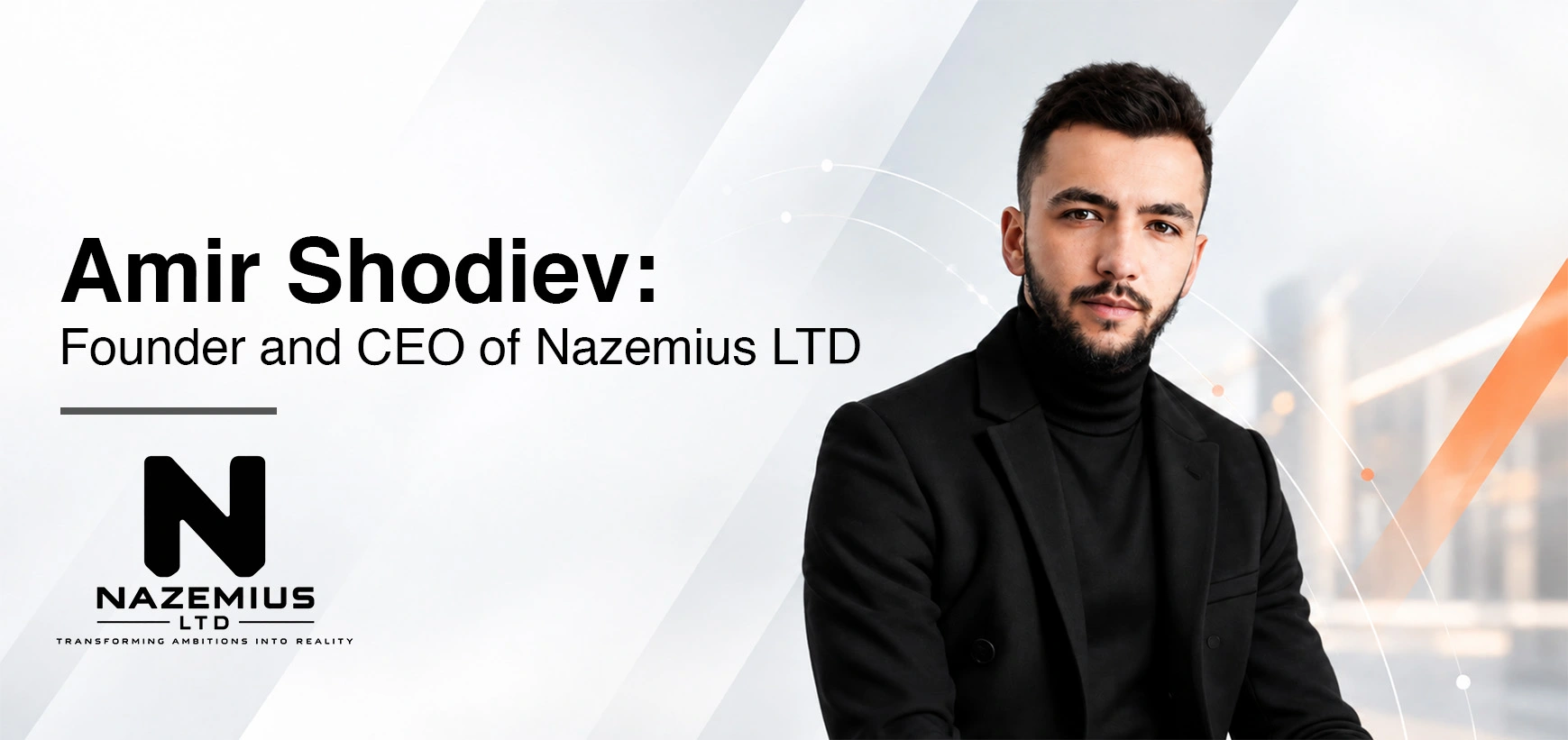
Amir Shodiev is the Founder and CEO of Nazemius LTD, a UK-based technology company developing MARK AI, an autonomous AI platform for business operations. With academic backgrounds in Finance and Engineering and professional experience across multiple industries in the UAE, he focuses on solving business challenges through technology, practical innovation and long-term thinking.


Connect with Amir Shodiev
Interested in working with or consulting with this expert? Submit your details below.